
AI video analytics
Your cameras already see everything. Now they notice.
23 detection modules run on the cameras you already own. Each event is checked by AI before anyone is disturbed and described in plain English, so your team reads what happened instead of watching for it.
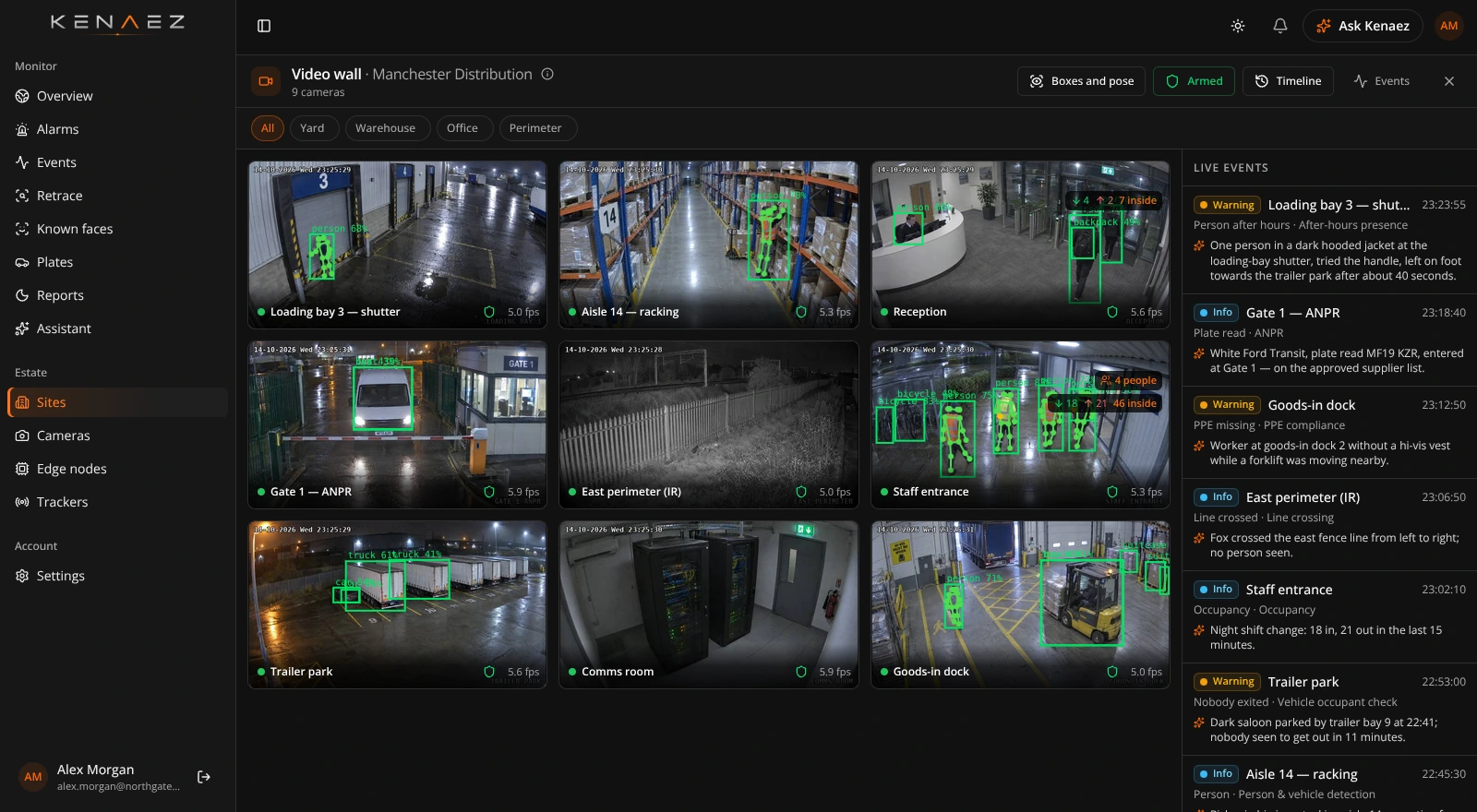
From frame to phone
Fewer, better alerts, each one already explained.
On site, every frame
The edge node finds and tracks people and vehicles, reads posture where a module needs it, and applies your lines, zones and schedules.
AI looks before you do
Each candidate event is checked by a vision model. False alarms are turned down; serious ones can escalate to a stronger model.
One sentence, not an hour
The event arrives with a plain-English summary, a still and, for warning and critical events, a short clip.
The right person, the right way
The video wall, the app and email by rules you set per module and severity, with quiet hours that critical events always break through. WhatsApp too, from your own business account.
The AI guard
A guard on every site. A person makes the call.
Every site gets an AI guard, switched on from day one. It watches your cameras, takes a quick look when something seems wrong, investigates the serious moments with the footage around them, then hands a short, plain-English report to a person.
Every frame, on site
The edge node watches every camera you license, including how crowds move, and asks for attention only when something looks out of place.
One quick question
A fast AI look answers one question: nothing, unclear or incident. Unclear holds the camera, so the next signal goes straight to a full investigation.
Like a guard would
The clip, more frames, the cameras either side, the last hour of events and what the site has marked as normal, then one verdict with the pictures to open first.
Your call, every time
A short report, a band from confirmed to nothing and a recommended action, pushed to everyone who can see that camera. A person decides what happens.
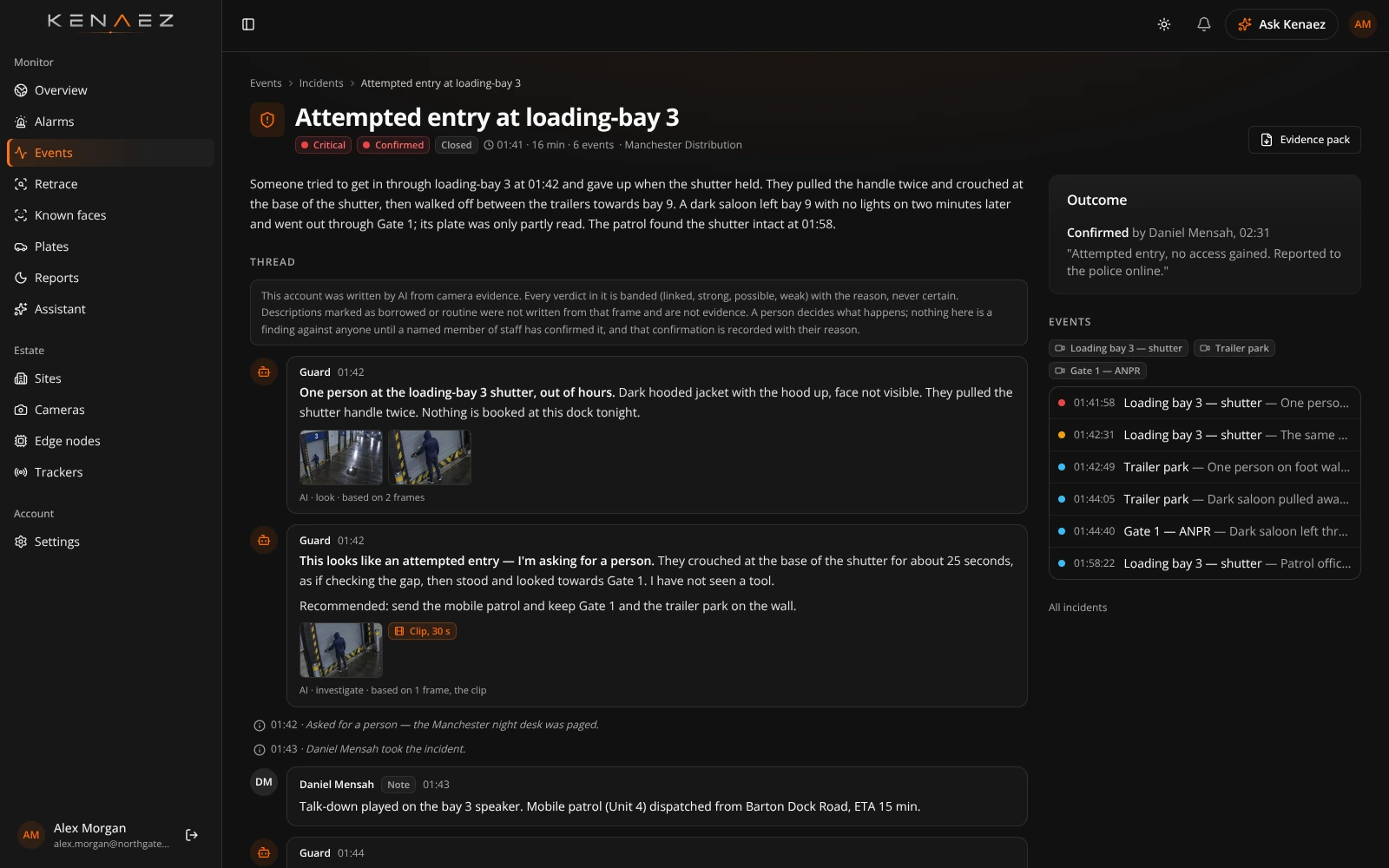
Incidents your team can close.
- Respond, add notes and record the outcome in one incident thread
- Every outcome labels the alerts inside it, so accuracy per camera is measured, not guessed
- A false alarm caused by staff, furniture or a reflection marks that scene as normal, so the camera stops asking
- Nothing is dropped: once a camera's daily investigations are used, serious events go straight to a person with a note saying why
- Verdicts are bands, never percentages; the guard never identifies anyone and never says staff or police were told unless they were
Crowd watch · Included
It notices how a crowd moves.
Crowd watch reads the movement of everyone in view and flags the patterns that come before trouble, so the guard can take a look. It comes with every licensed camera.
- Running, a crowd scattering, people converging on one spot, someone moving against the flow, a sudden rise in density, and a group splitting apart
- Measured in body-heights per second, so a child and an adult read the same
- Scattering is judged by where people are, not by following each person, so a lost track cannot hide it
- The most serious signals keep a 20-second clip and a full-resolution picture of where it started
The modules
23 modules, three price bands, licensed per camera.
Prices follow what each module costs to run, not what it sounds like. Every limit below is shown in the app too, because an alert you misunderstand is worse than no alert.
Awareness on every camera
£3 per camera per month · 150 AI credits
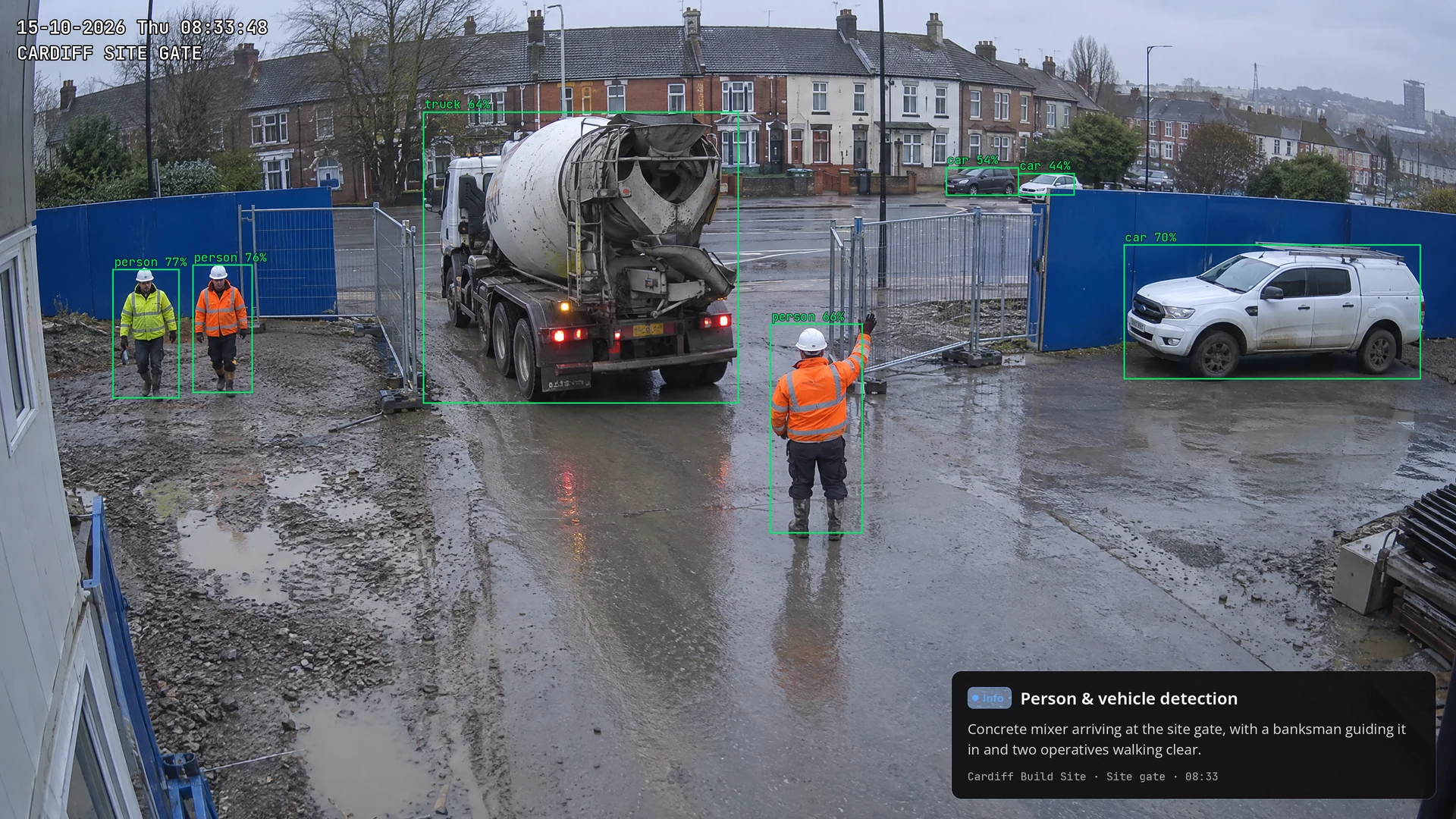
Person and vehicle detection
Detects and classifies people and vehicles entering view. The foundation for perimeters, car parks and yards.
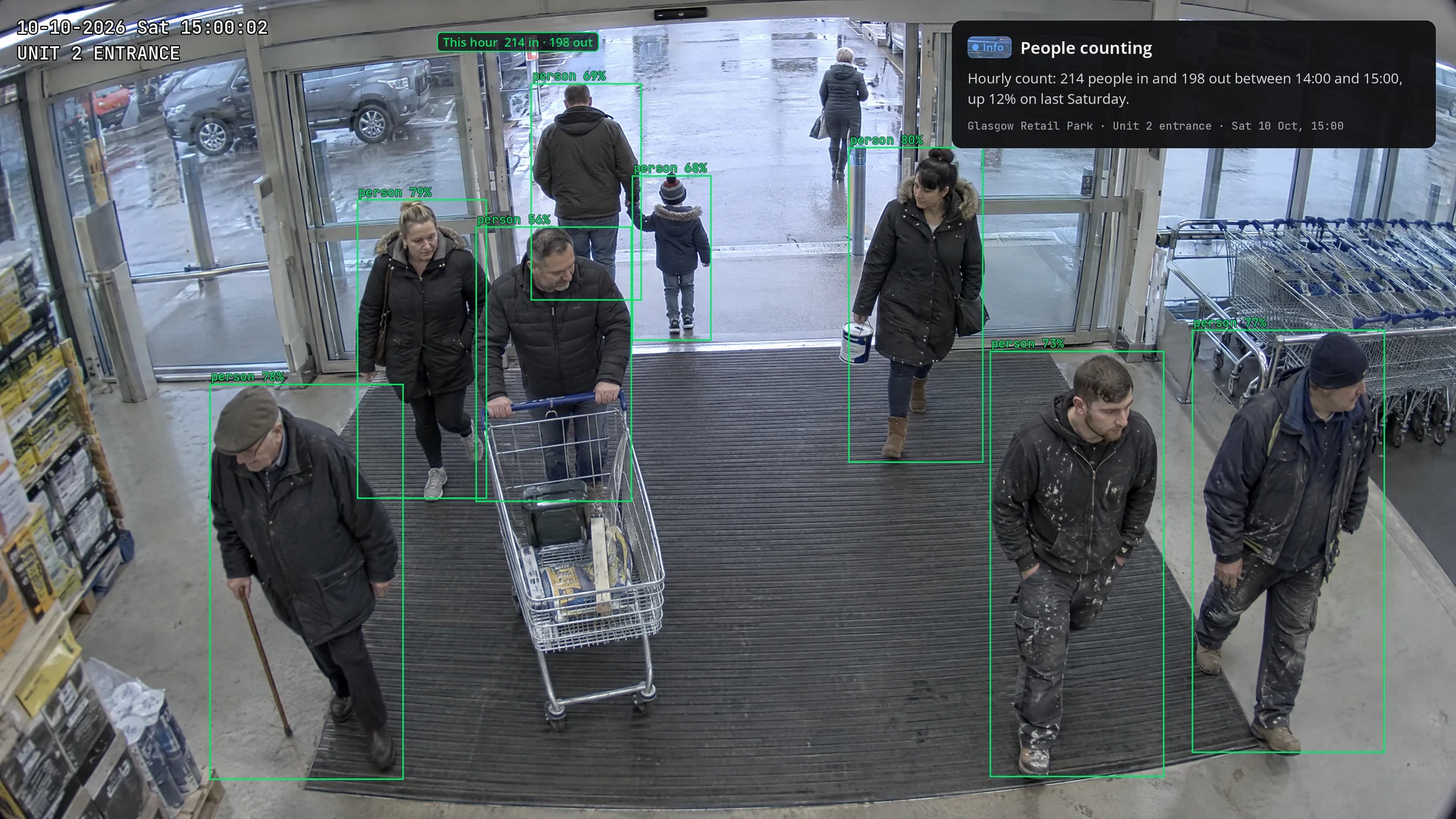
People counting
Counts people entering and leaving a space in real time, for footfall and occupancy management.
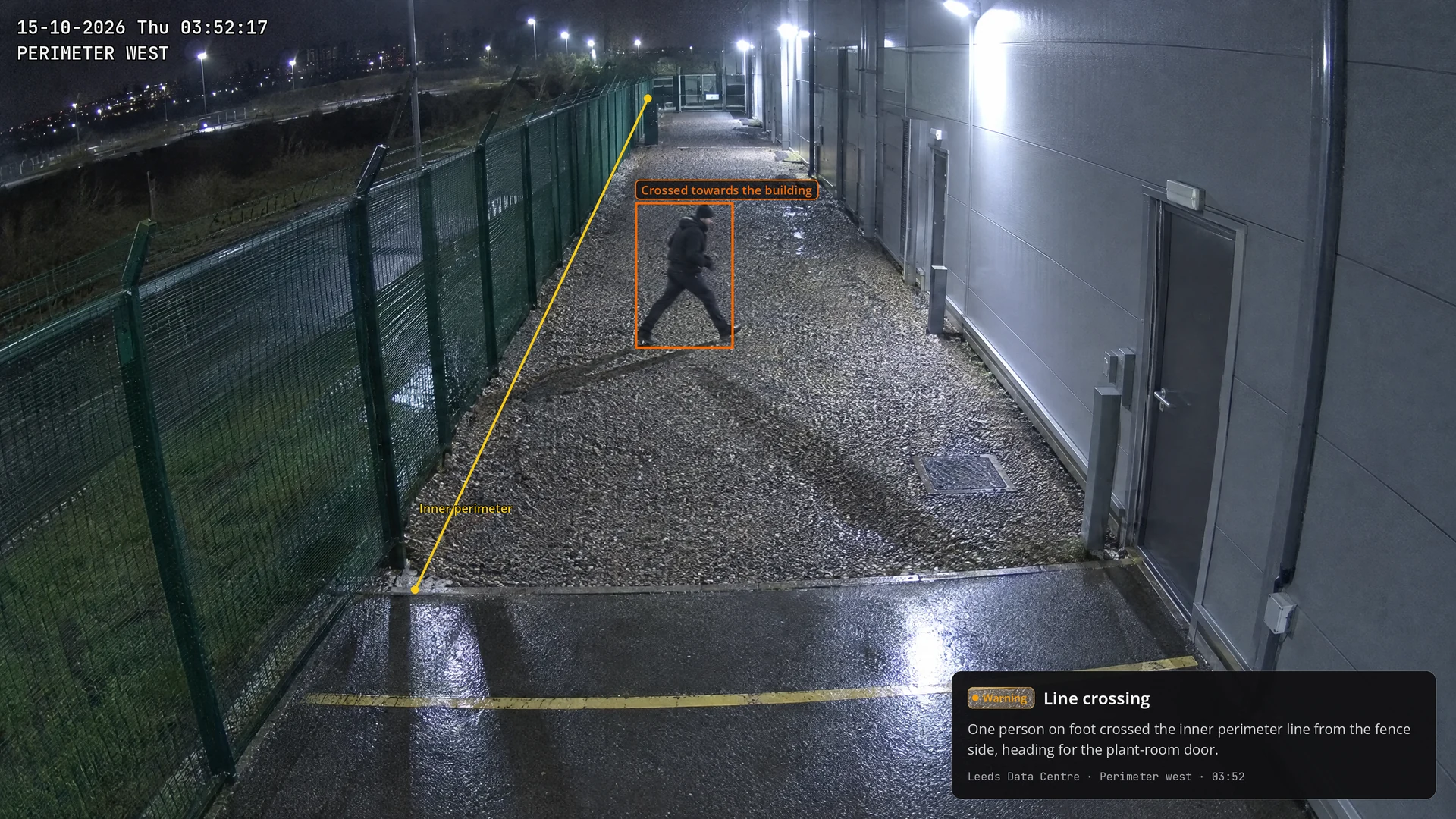
Line crossing
Alerts when a person or vehicle crosses a virtual line you draw, in the direction you choose.
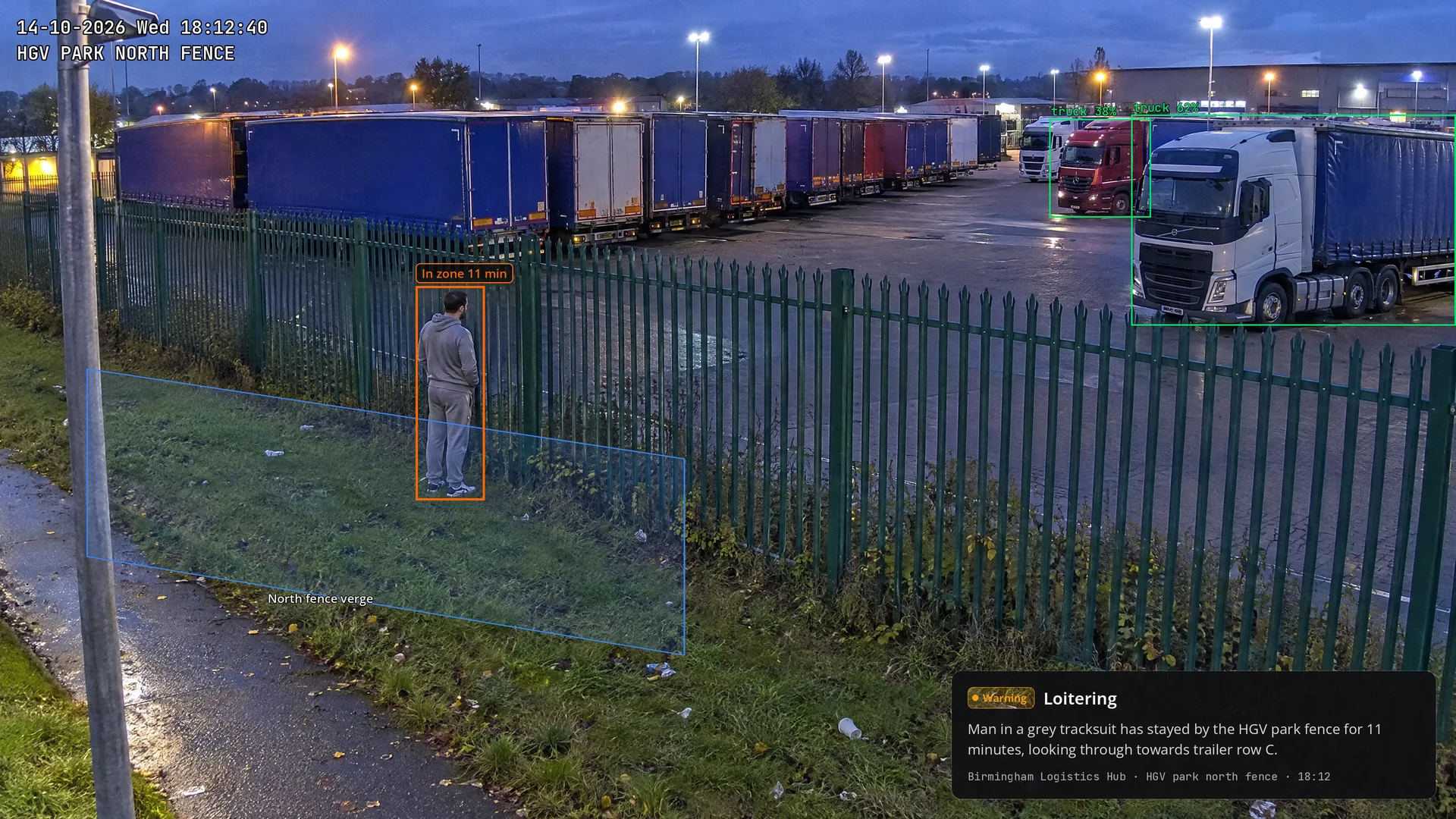
Loitering detection
Alerts when someone stays in a zone longer than your threshold. Entrances, car parks, restricted areas.
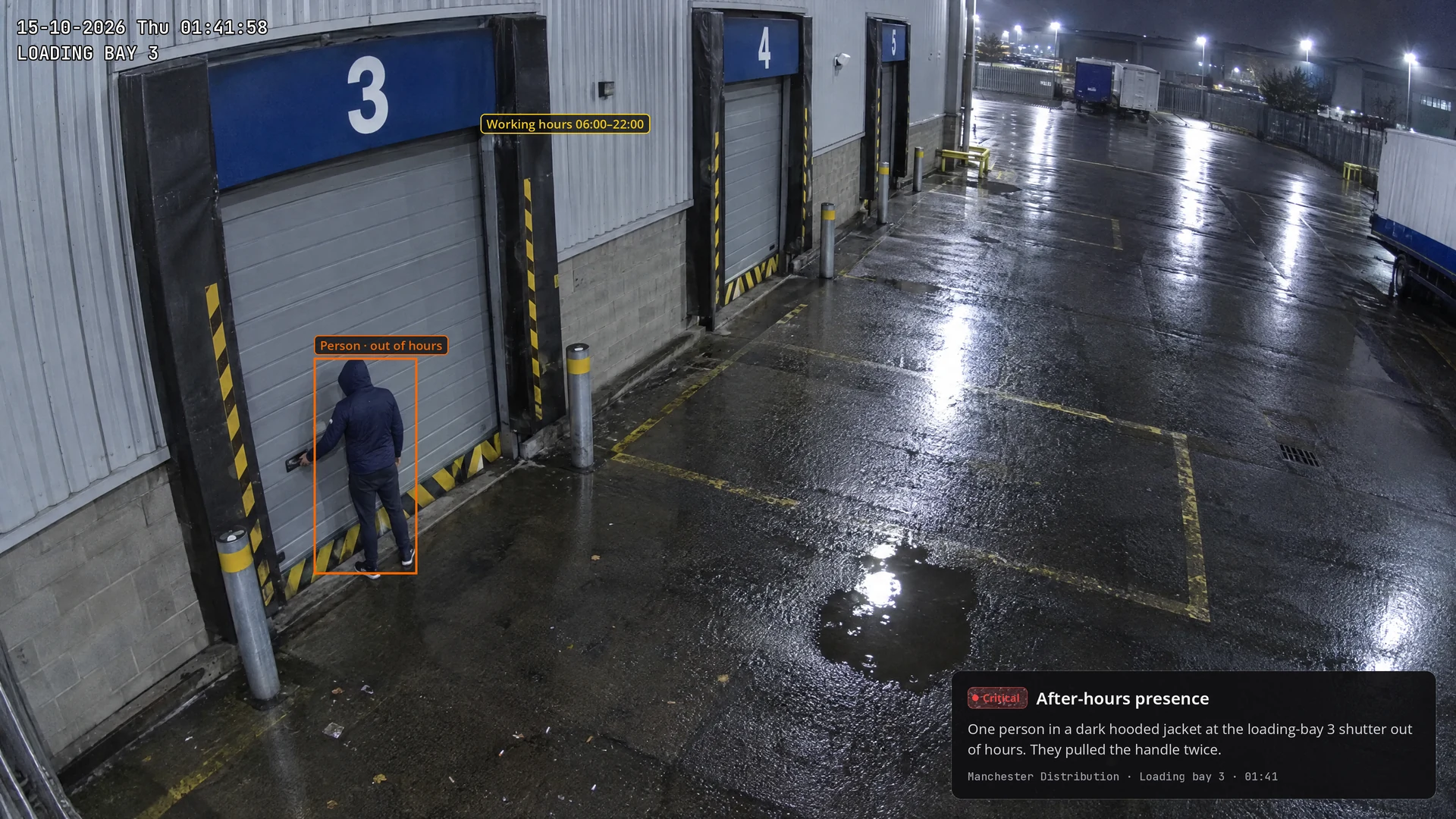
After-hours presence
Alerts on people in monitored areas outside the operating hours you set for each site.
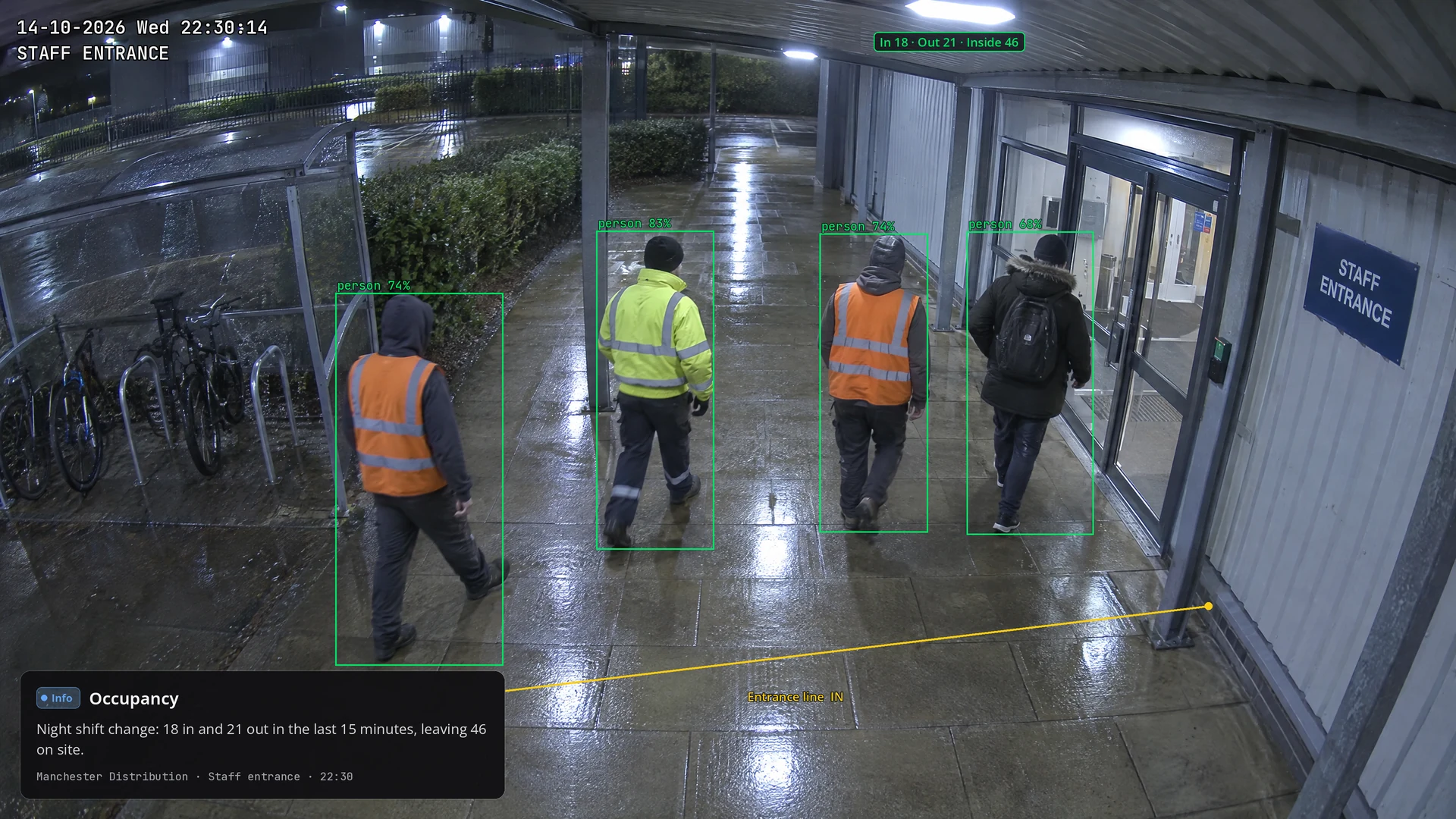
Occupancy monitoring
Entries, exits and current occupancy per time window, live on the wall and logged for history.
An estimate that depends on good line placement, not a certified people counter.
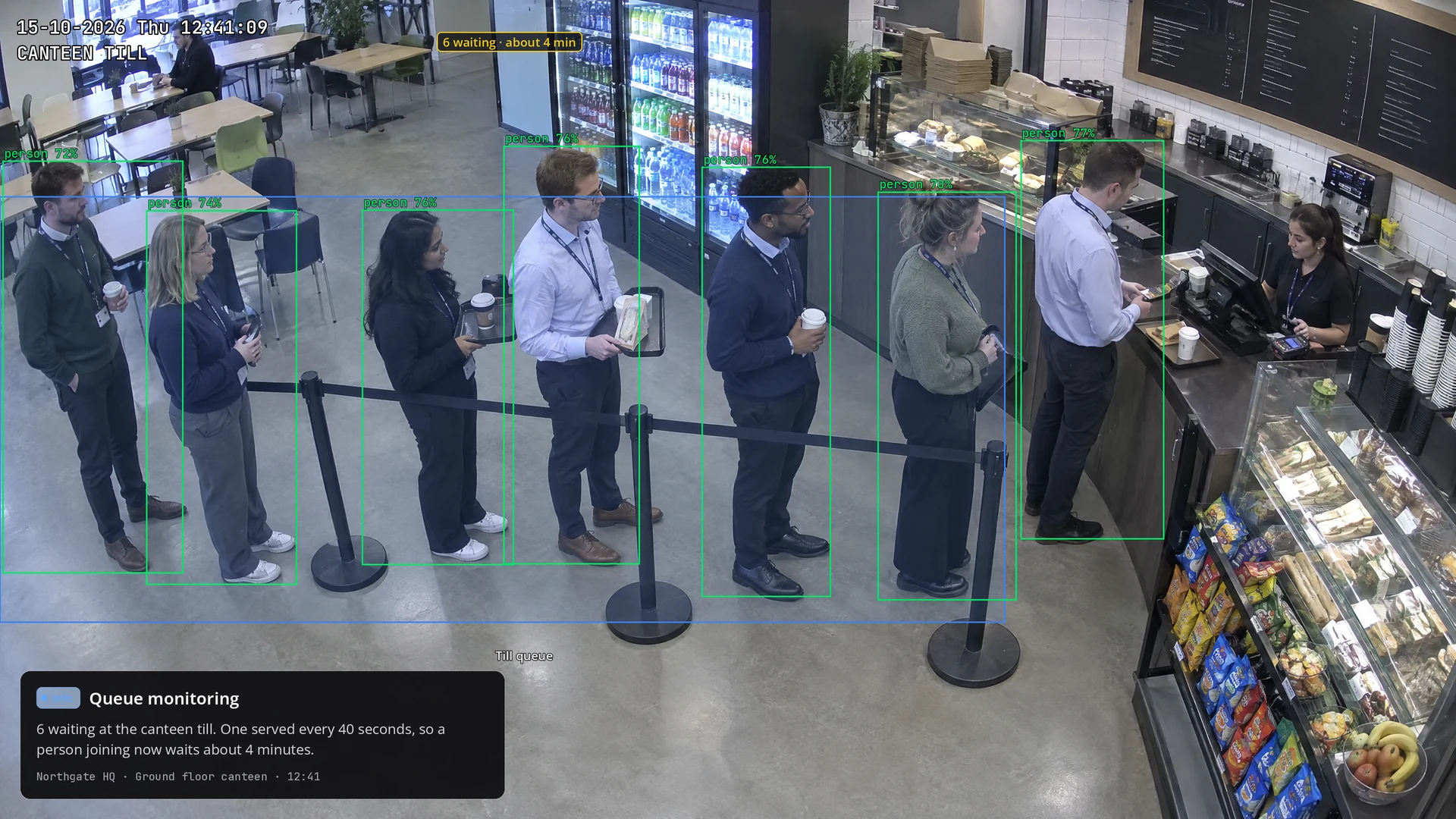
Queue monitoring
How many people are waiting and an estimated wait, measured from how fast the queue actually clears.
Reported as unknown until the queue has moved enough to measure, never as zero.
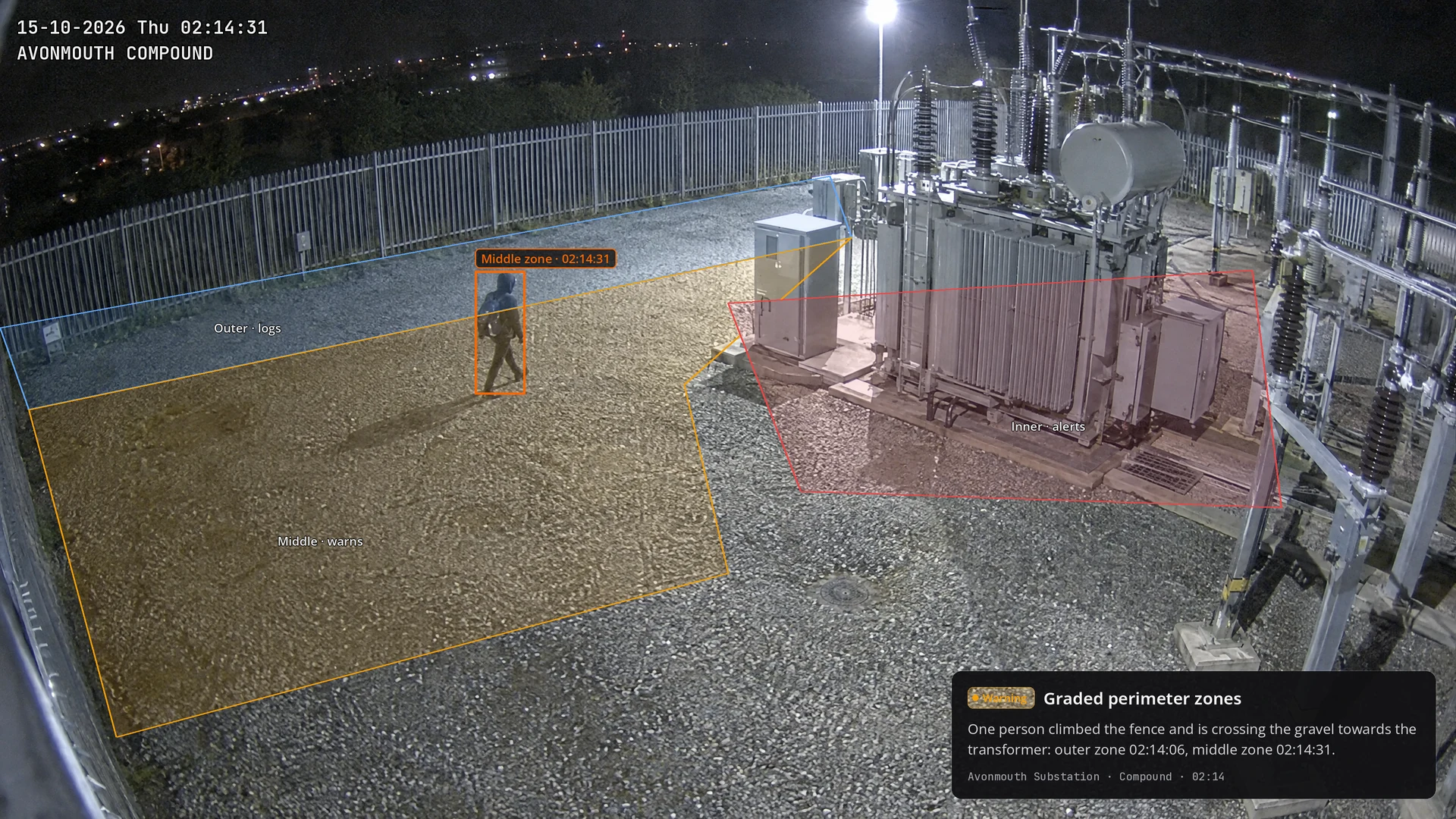
Graded perimeter zones
Label zones outer, middle or inner: outer logs, middle warns, inner alerts. Progression is recorded, so intent is visible.
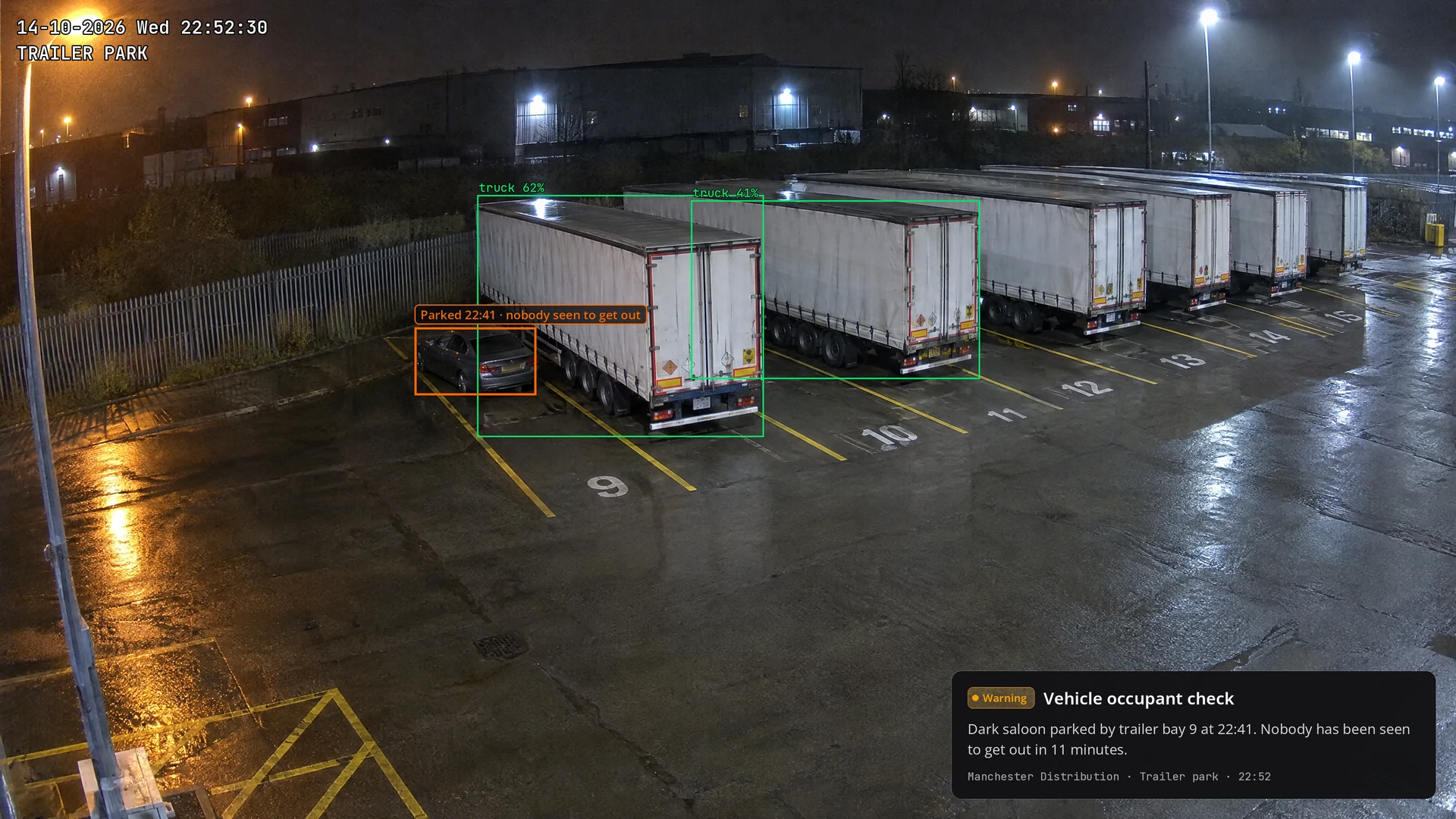
Vehicle occupant check
Flags a vehicle that parks with nobody seen getting out, a classic sign of someone watching a site.
Tinted glass or a door on the far side can hide an occupant: "nobody seen" means exactly that.
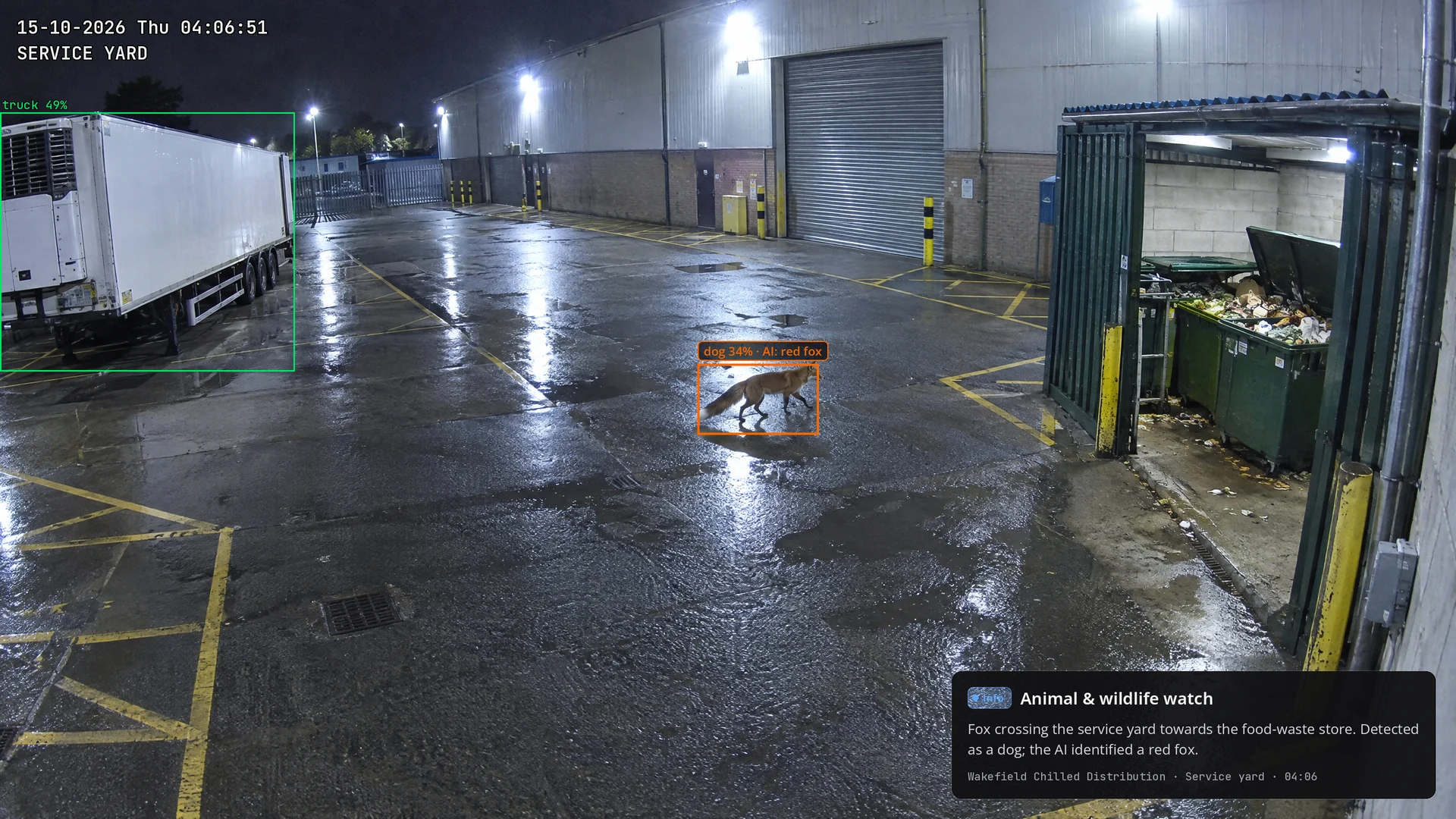
Animal and wildlife watch
Detects animals entering view and has AI identify them. Food premises, airfields, solar farms and warehouses.
Cannot detect rats or mice. This is not a pest-control product.
Safety, compliance and evidence
£6 per camera per month · 400 AI credits
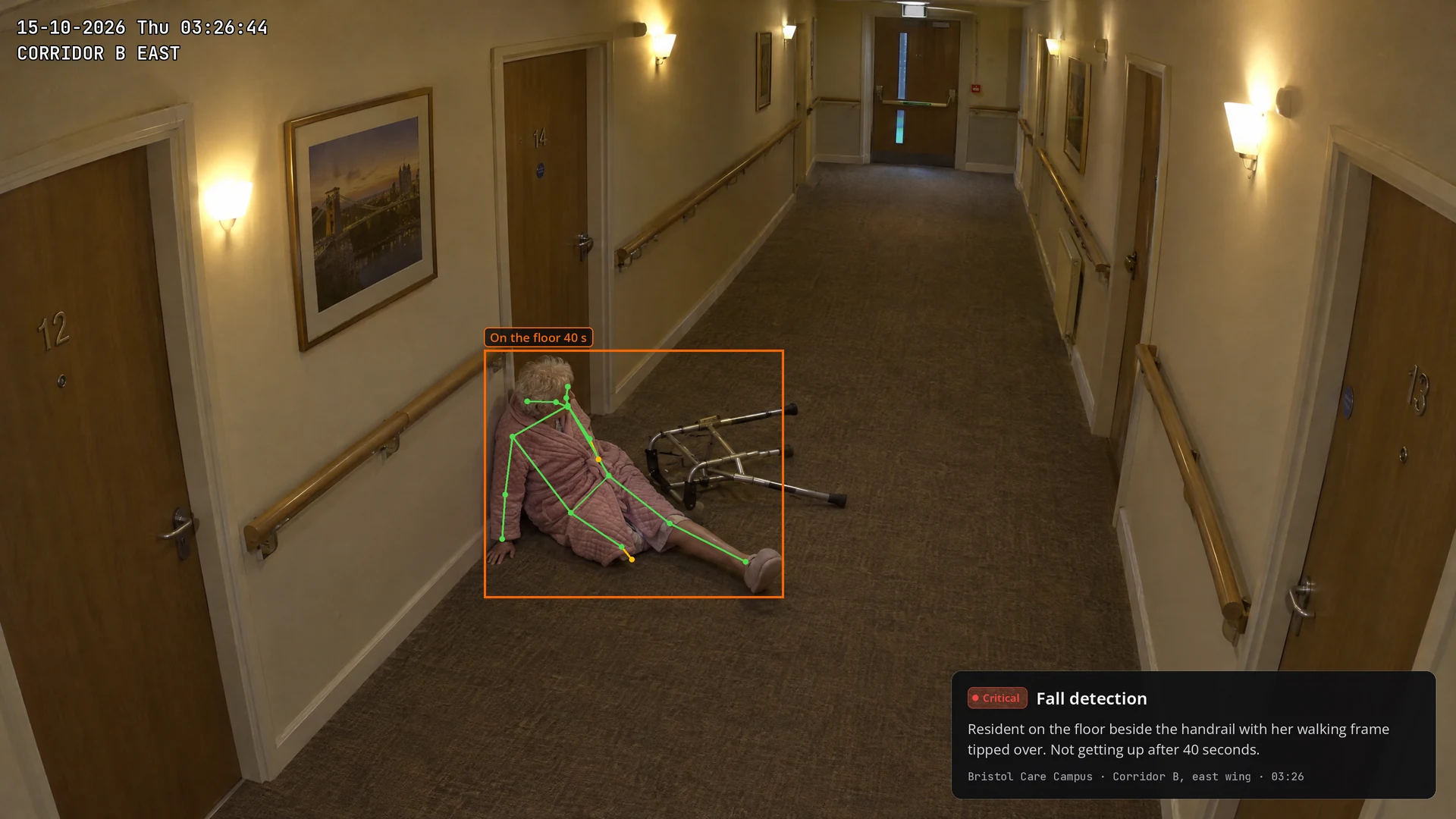
Fall detection
Detects a person who falls and stays down. Welfare monitoring for warehouses, plant rooms and lone workers.
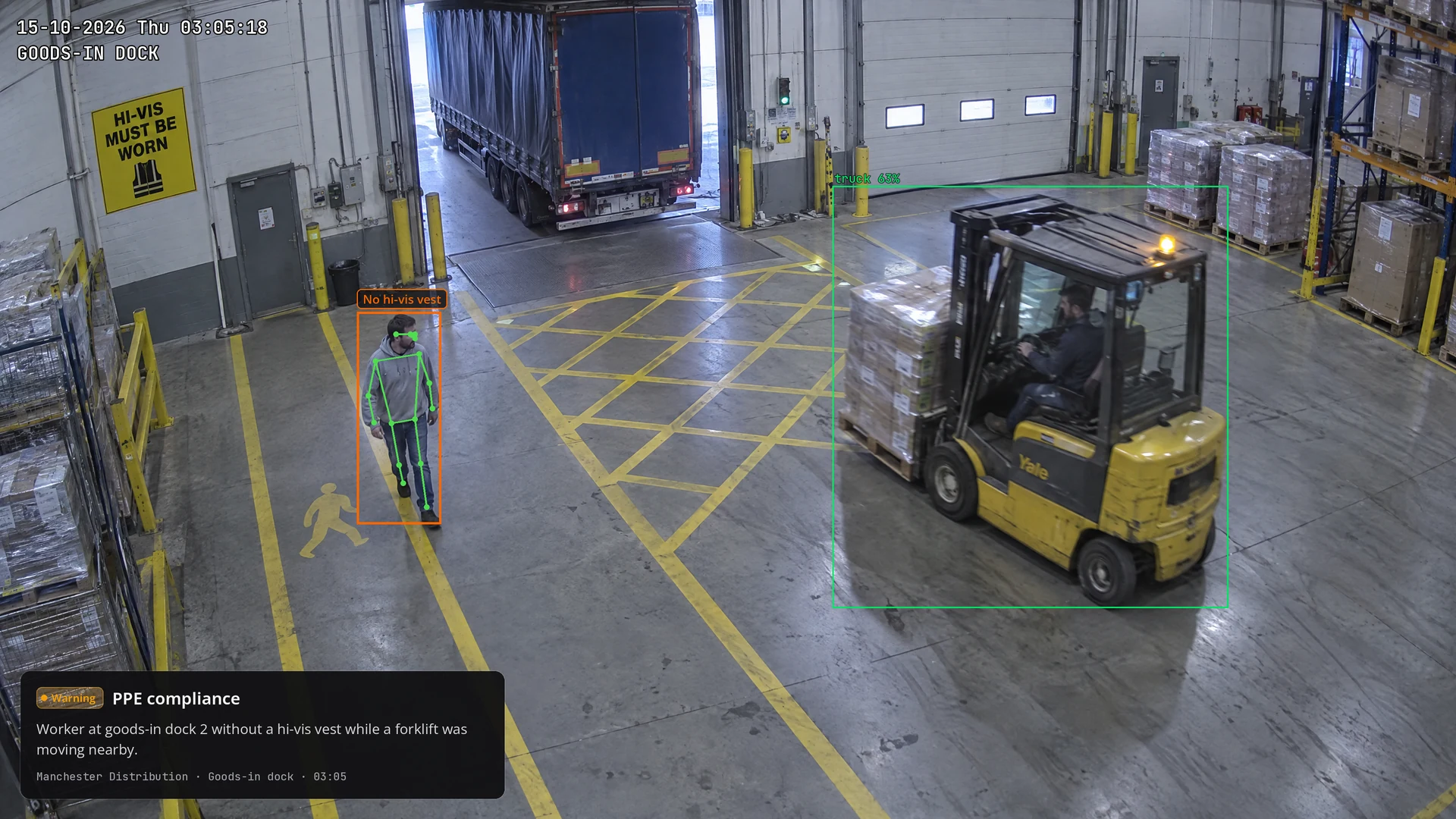
PPE compliance
Checks for hard hats, hi-vis and other protective equipment on construction sites and industrial floors.
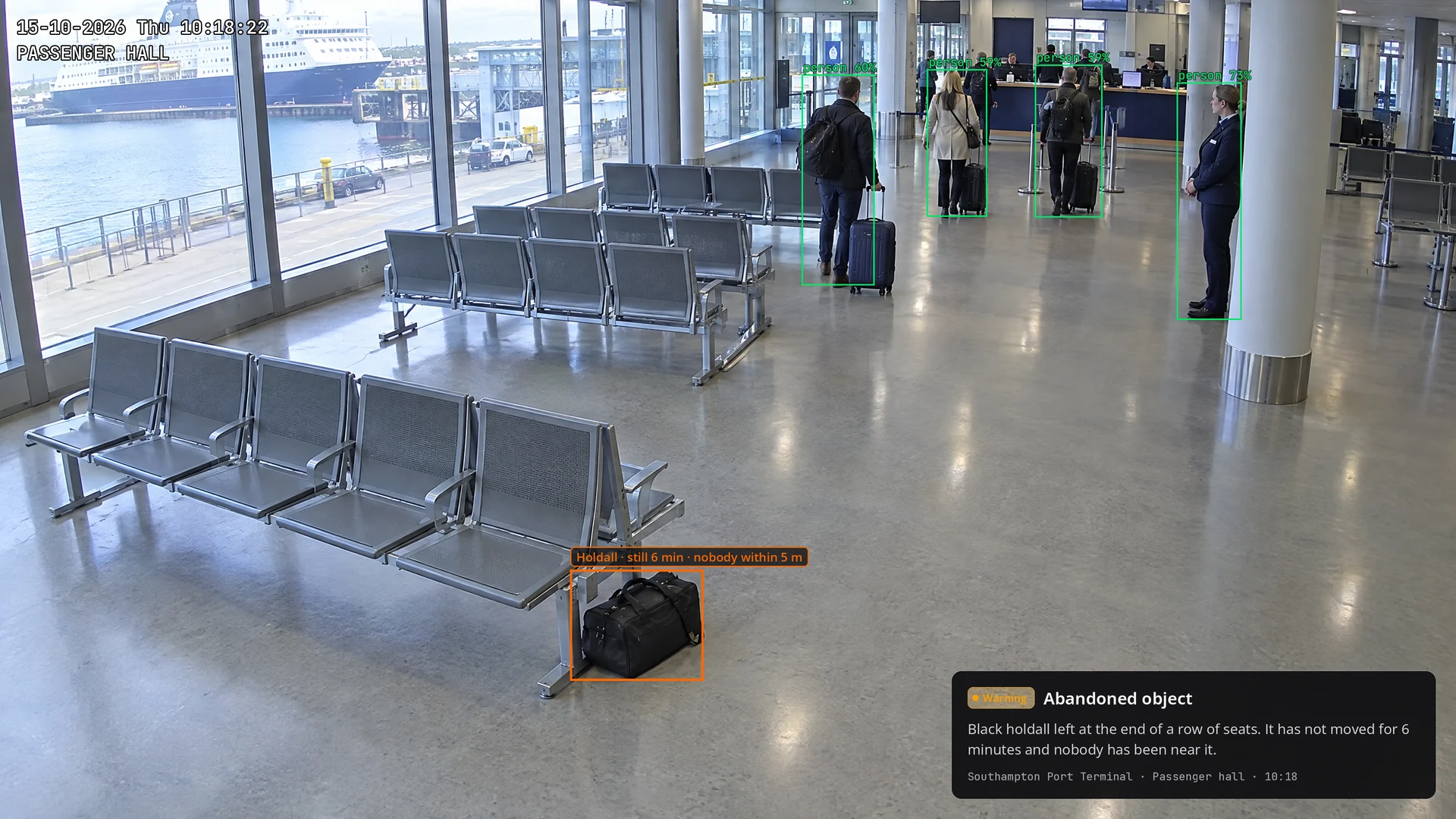
Abandoned object detection
Flags objects left unattended beyond the time you set, in lobbies, transport areas and public spaces.
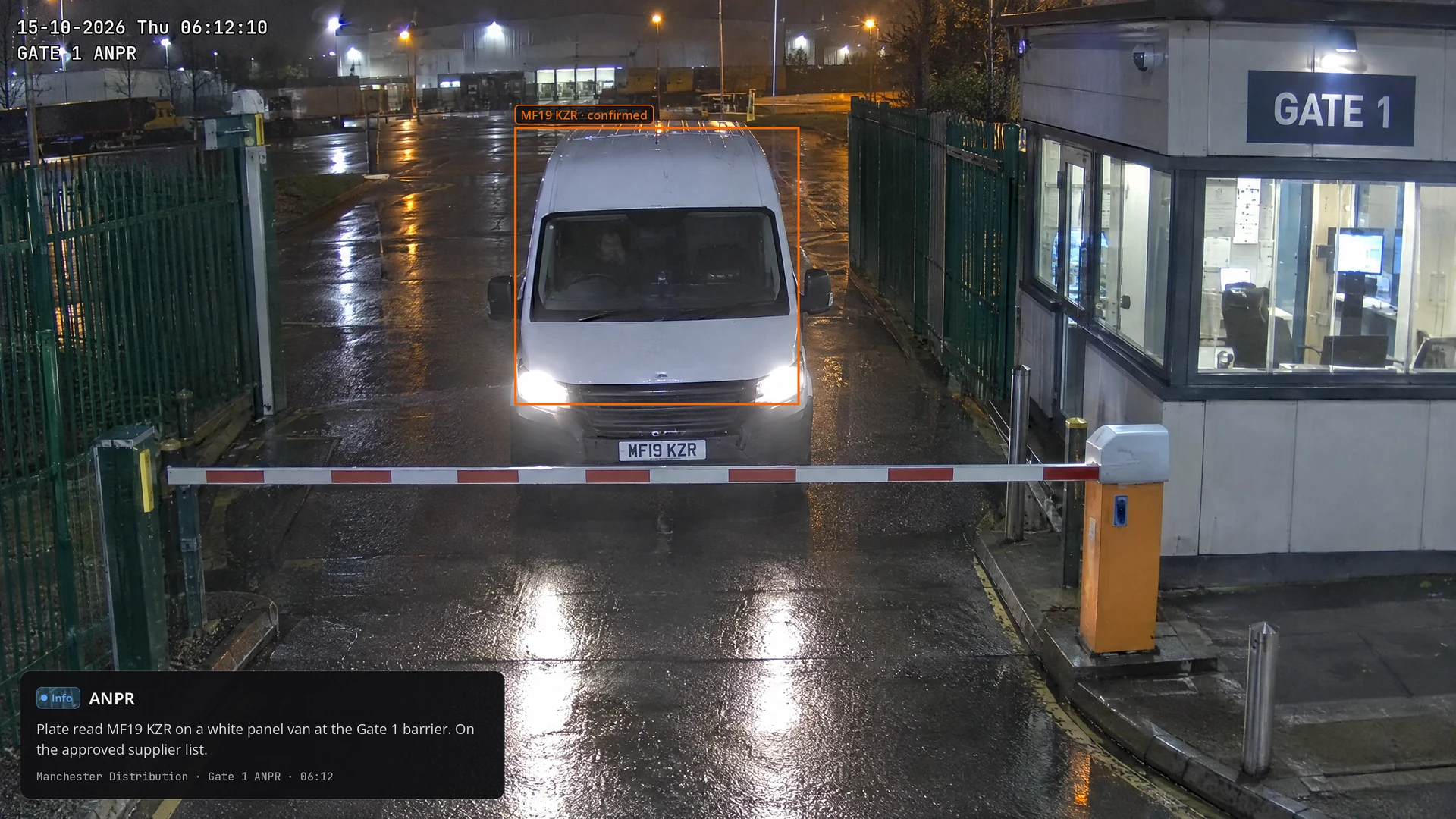
ANPR number plate recognition
Reads registrations, logs every sighting for search and checks each plate against your watchlist.
Partial reads are recorded but never matched. ANPR on private land in the UK needs appropriate signage.
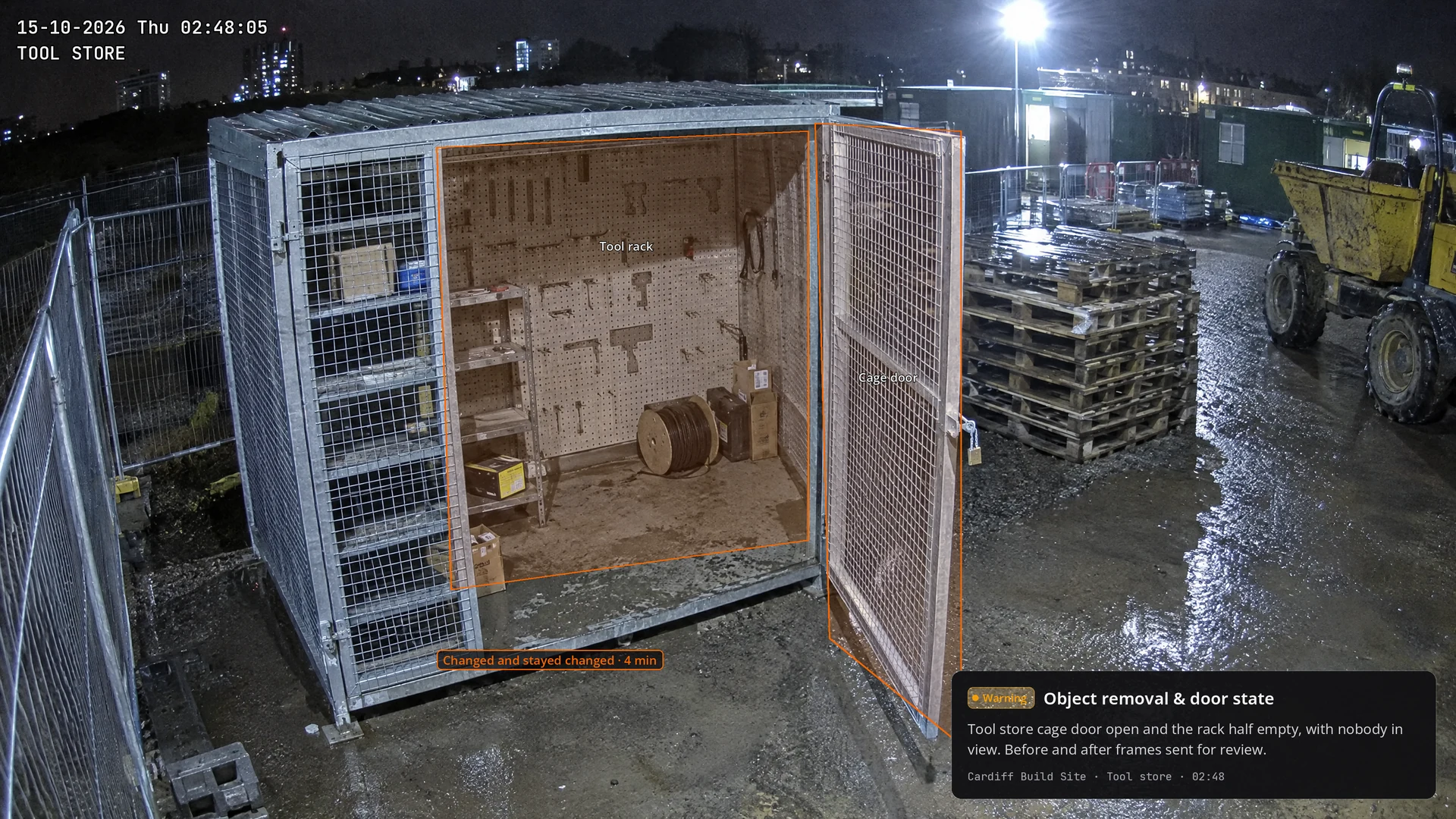
Object removal and door state
Reports when a region changes and stays changed: tools gone from a rack, stock off a shelf, a gate left open.
It can say a region no longer looks like itself, not whether something was stolen.
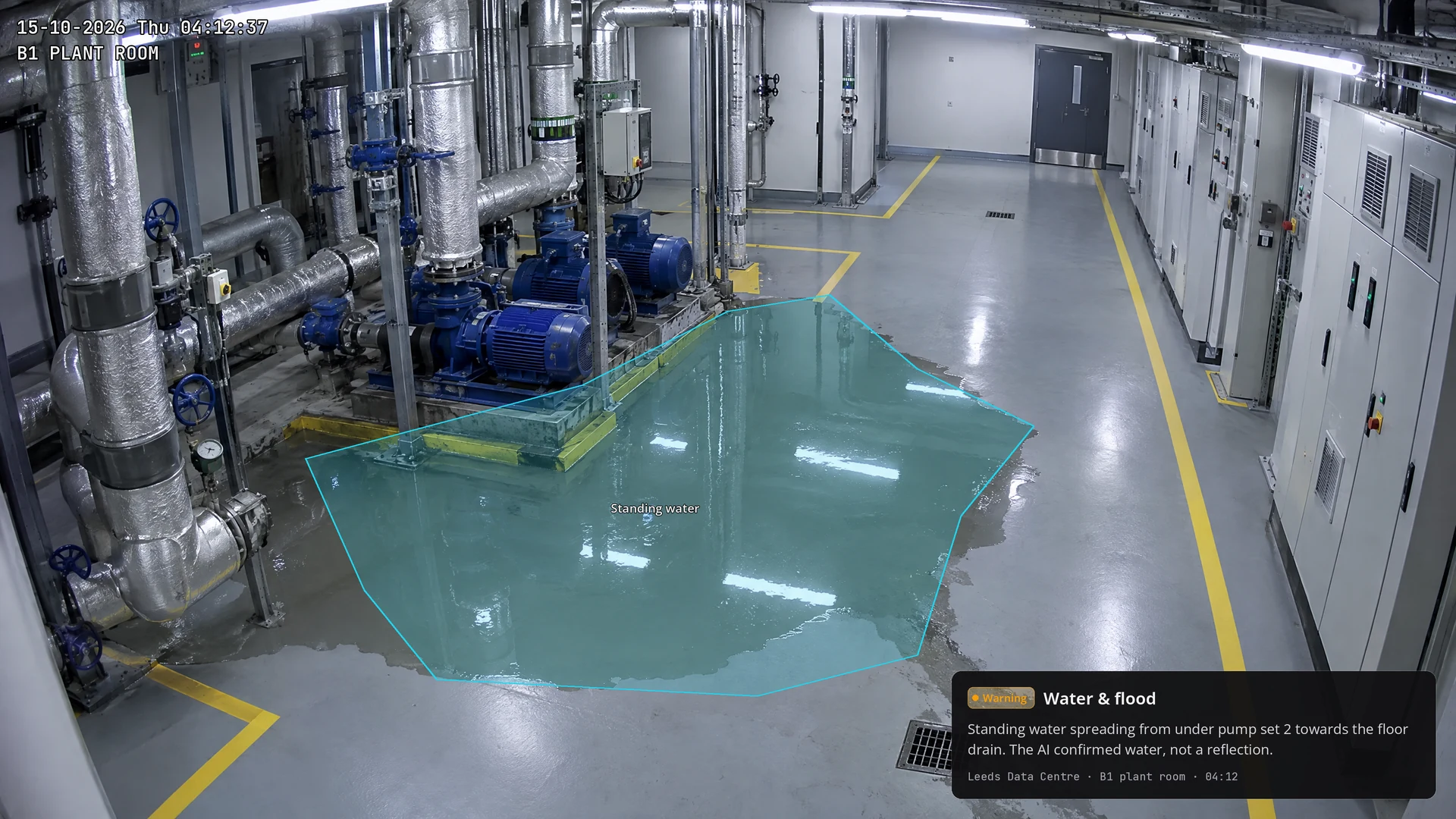
Water and flood detection
Watches plant rooms, basements, cellars and server rooms for standing water, confirmed by AI.
Not a substitute for a float switch or leak-detection cable on anything critical.
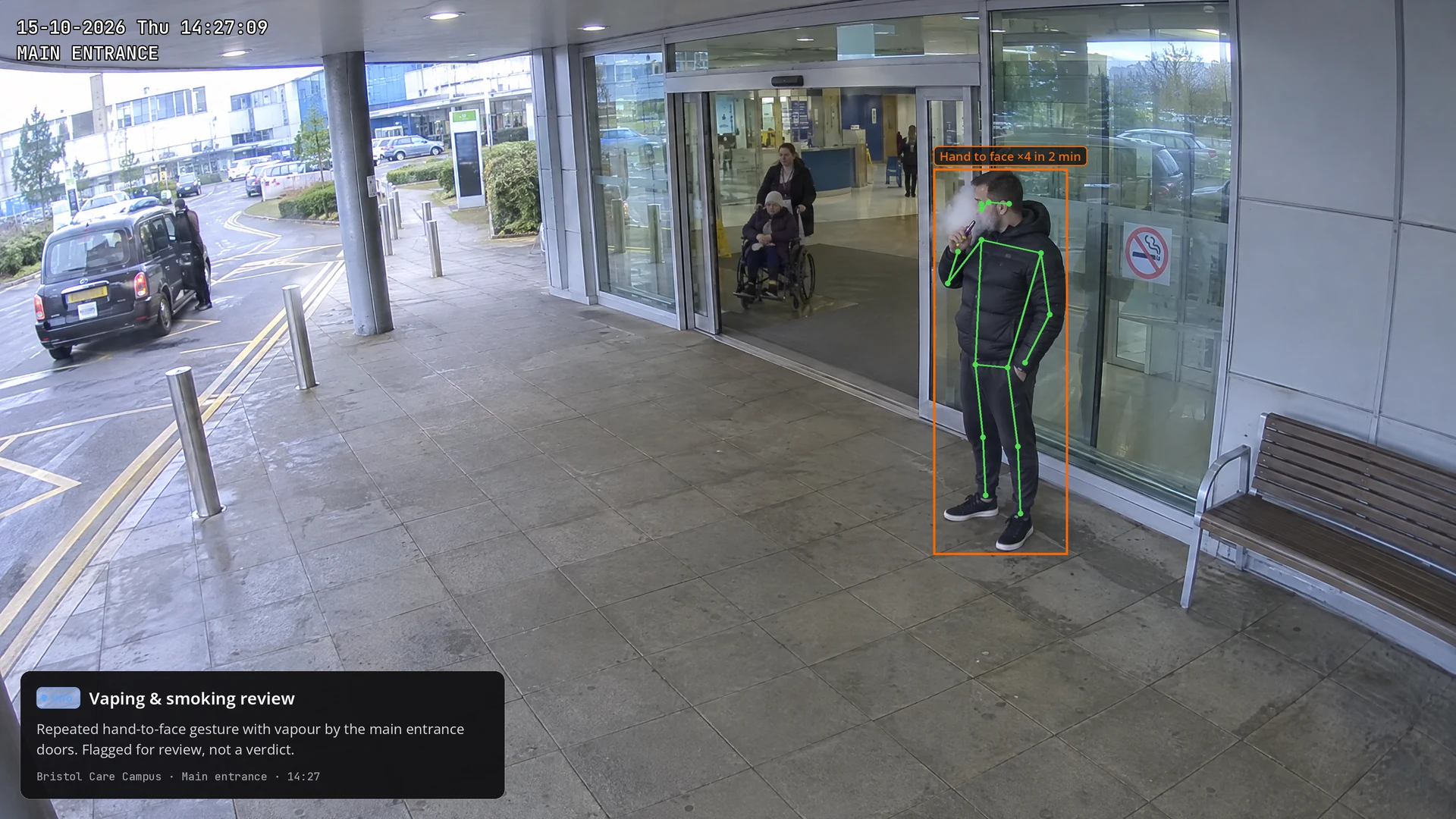
Vaping and smoking review
Flags repeated hand-to-face gestures with dwell for human review, at school doors, hospital entrances and licensed premises.
Eating, drinking and phone calls look similar. A review aid, never a verdict, and not an aerosol sensor.
High stakes and external feeds
£12 per camera per month · 800 AI credits
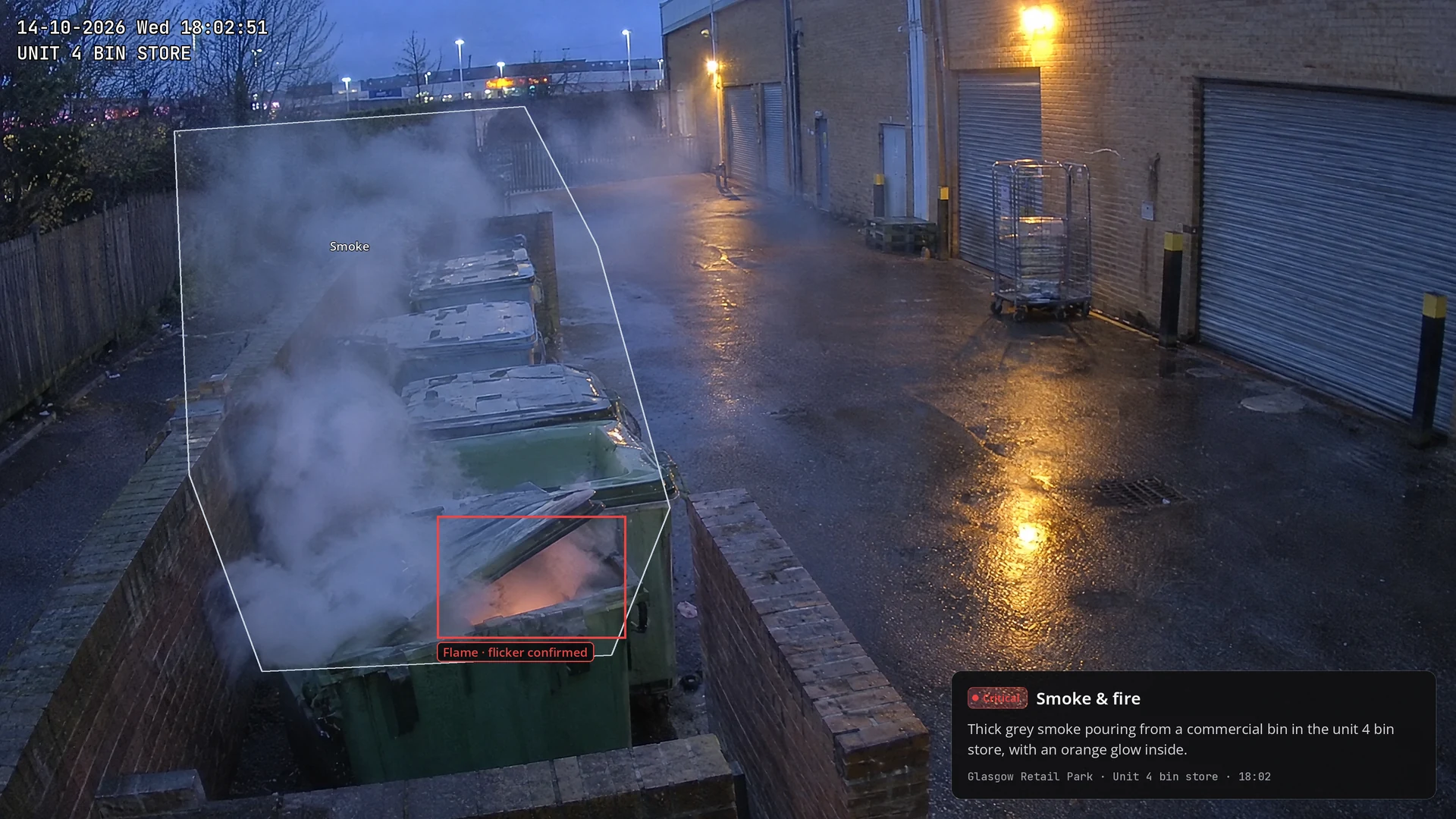
Smoke and fire detection
Visual detection of flame flicker and daylight smoke, verified by AI before alerting.
Supplementary only, never a replacement for a certified fire alarm. Less sensitive on infrared night mode.
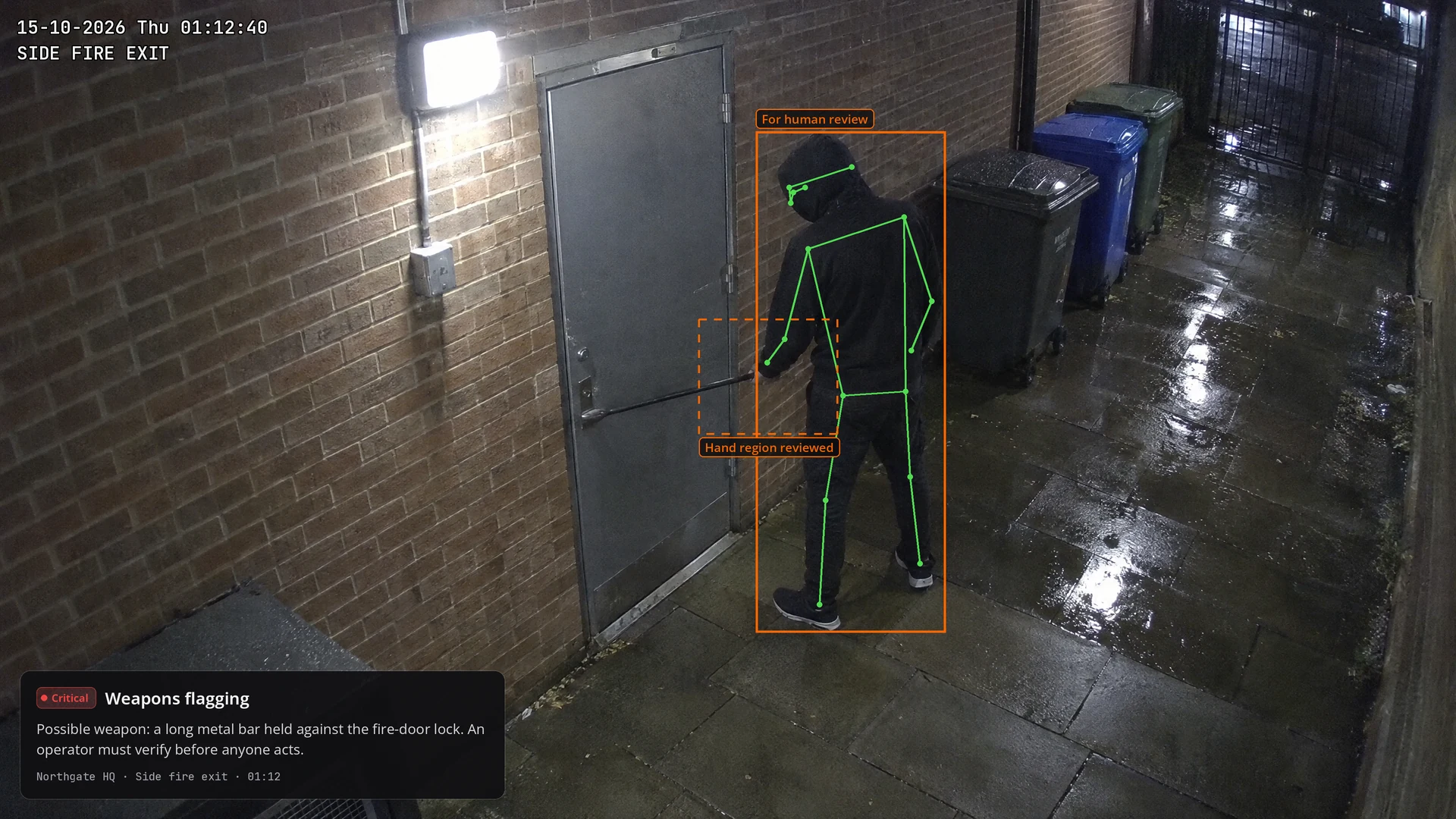
Weapons flagging
Flags the possible presence of a weapon for immediate human review.
A review aid, not a detection guarantee or a substitute for trained security staff.
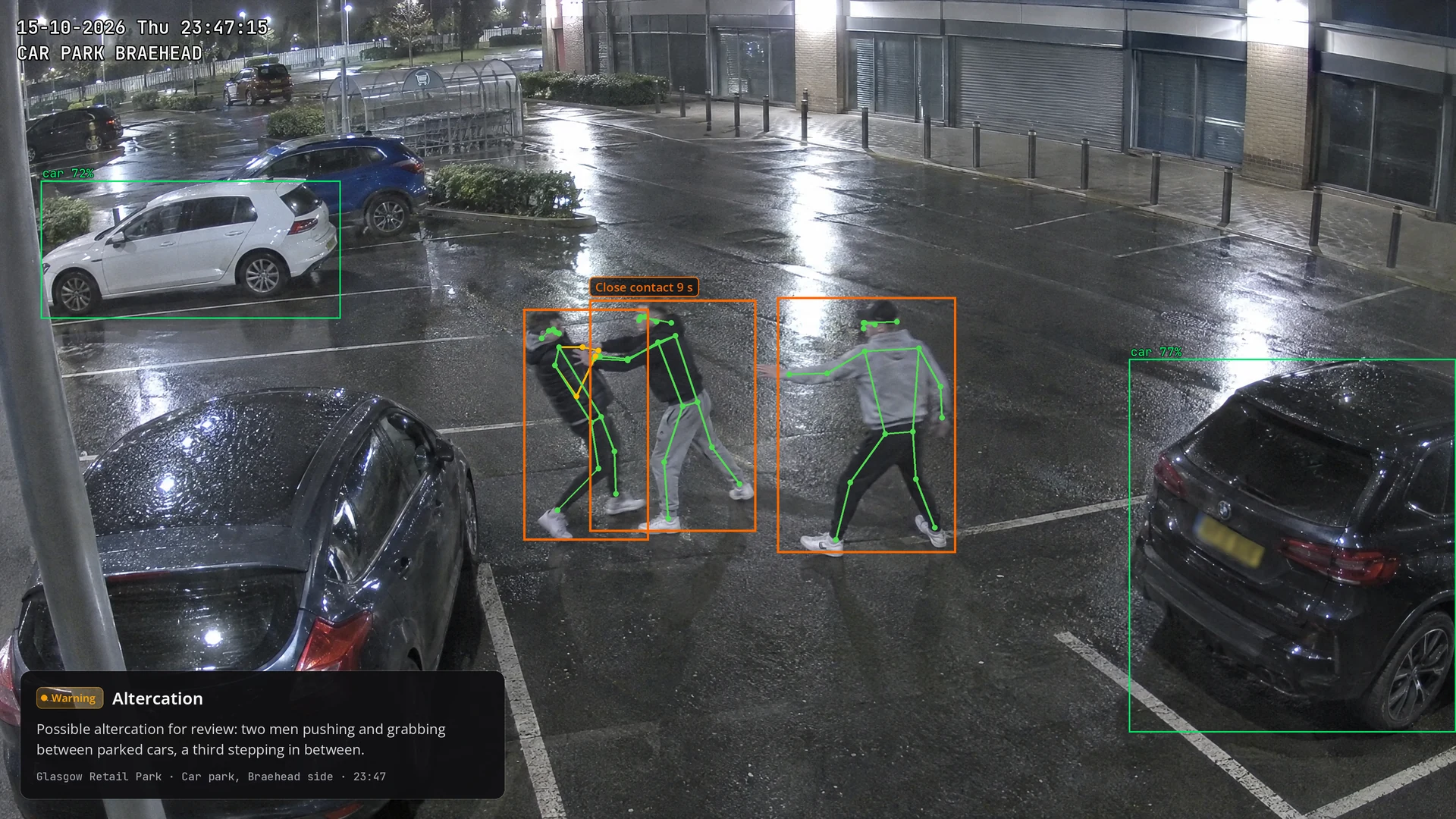
Altercation detection
Flags sustained close contact with rapid limb movement, verified by AI, for a person to review.
A review aid; an operator must verify every alert.
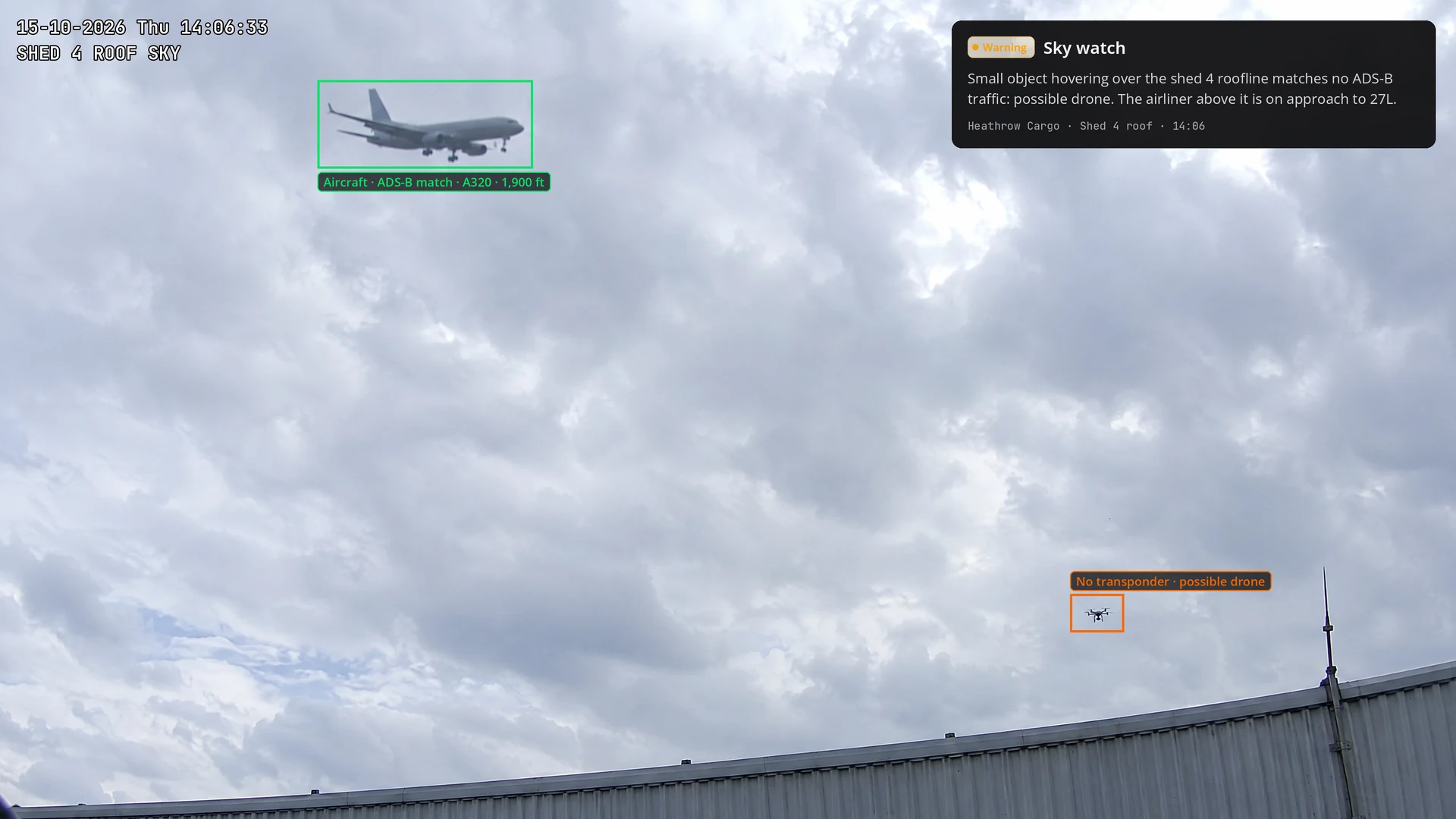
Sky Watch
Detects objects crossing the sky and matches them to live aircraft transponder data. An unmatched object, possibly a drone, raises an alert.
Optical range limits apply; at night only lit objects are visible.
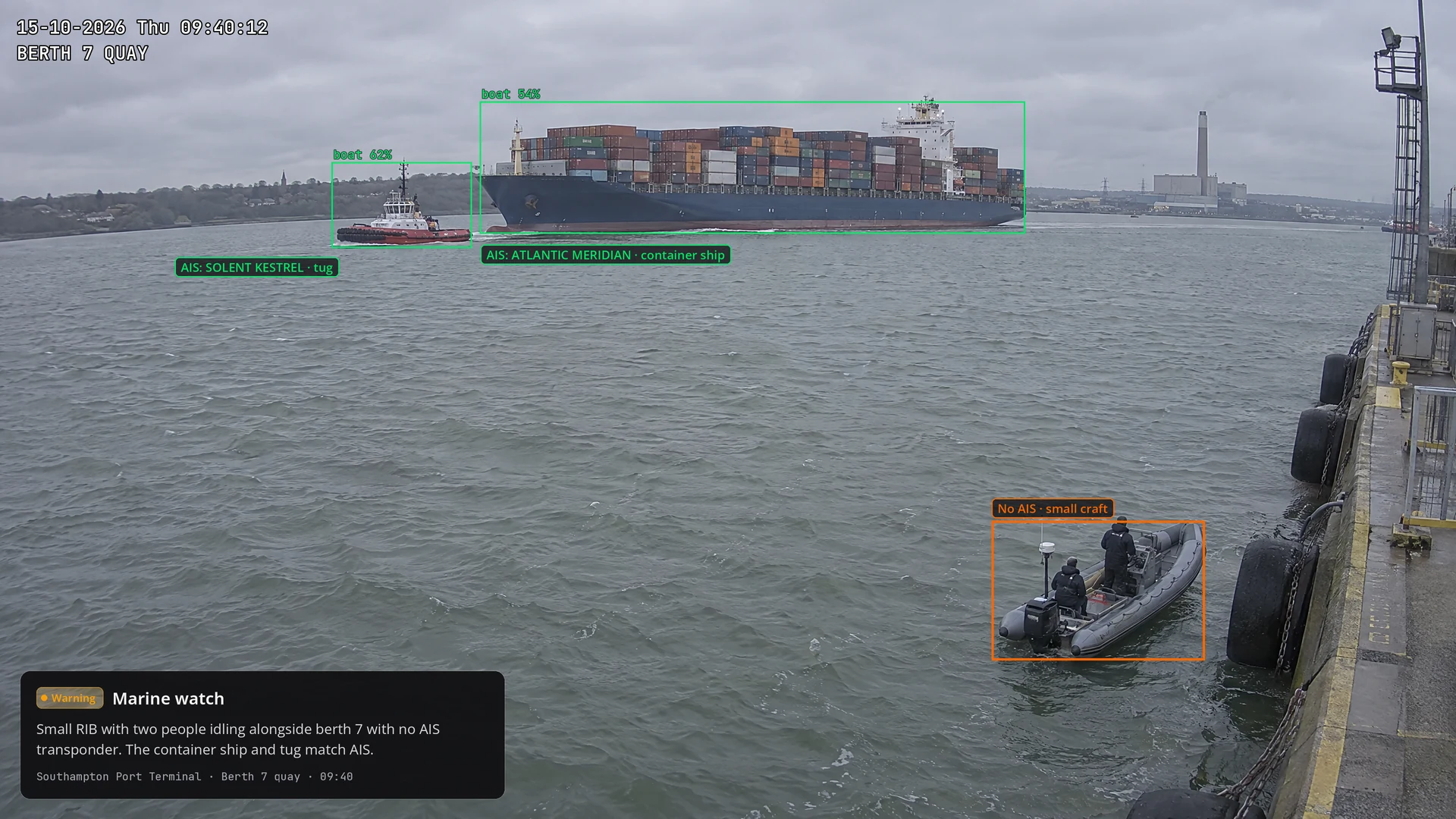
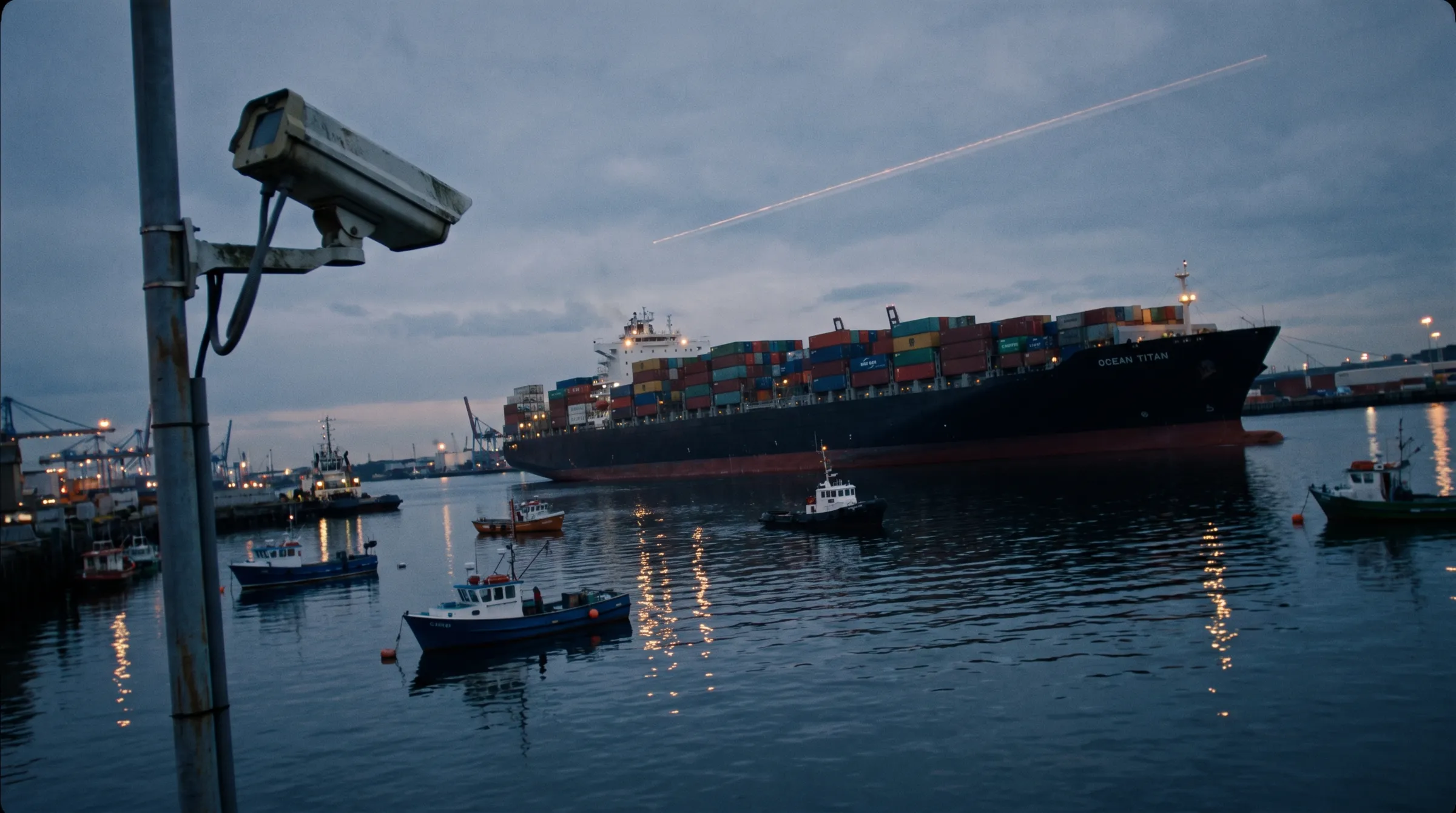
Marine Watch
Detects vessels and matches them to live AIS transponder data. A vessel broadcasting nothing raises an alert.
Small craft rarely transmit AIS. Needs the camera's position and bearing.
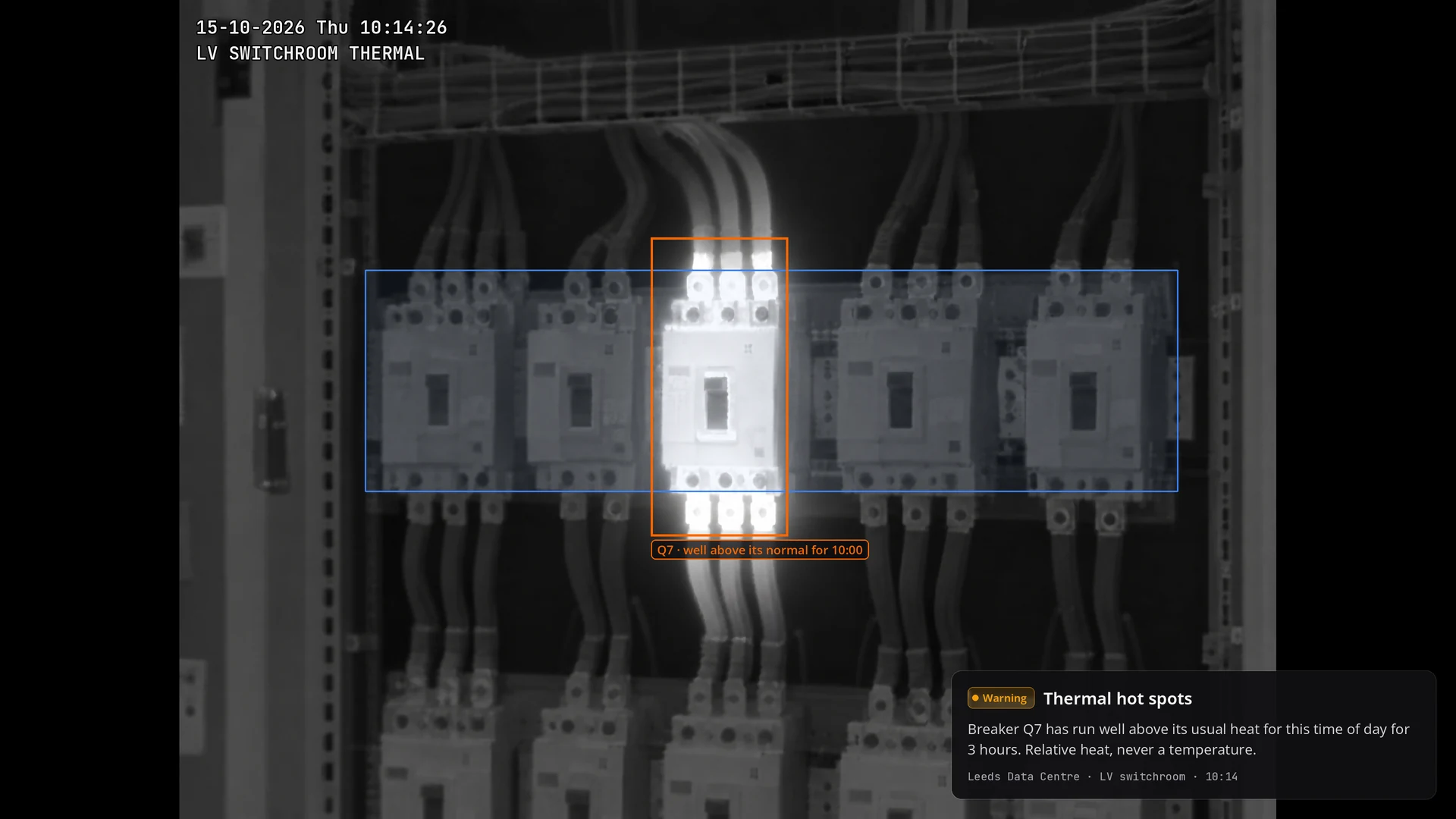
Thermal hot-spot detection
Learns the normal heat of a switchboard, motor or battery rack by time of day and reports a sustained rise, days before failure.
Thermal cameras only, set to white-hot. Reports heat relative to normal, never degrees.
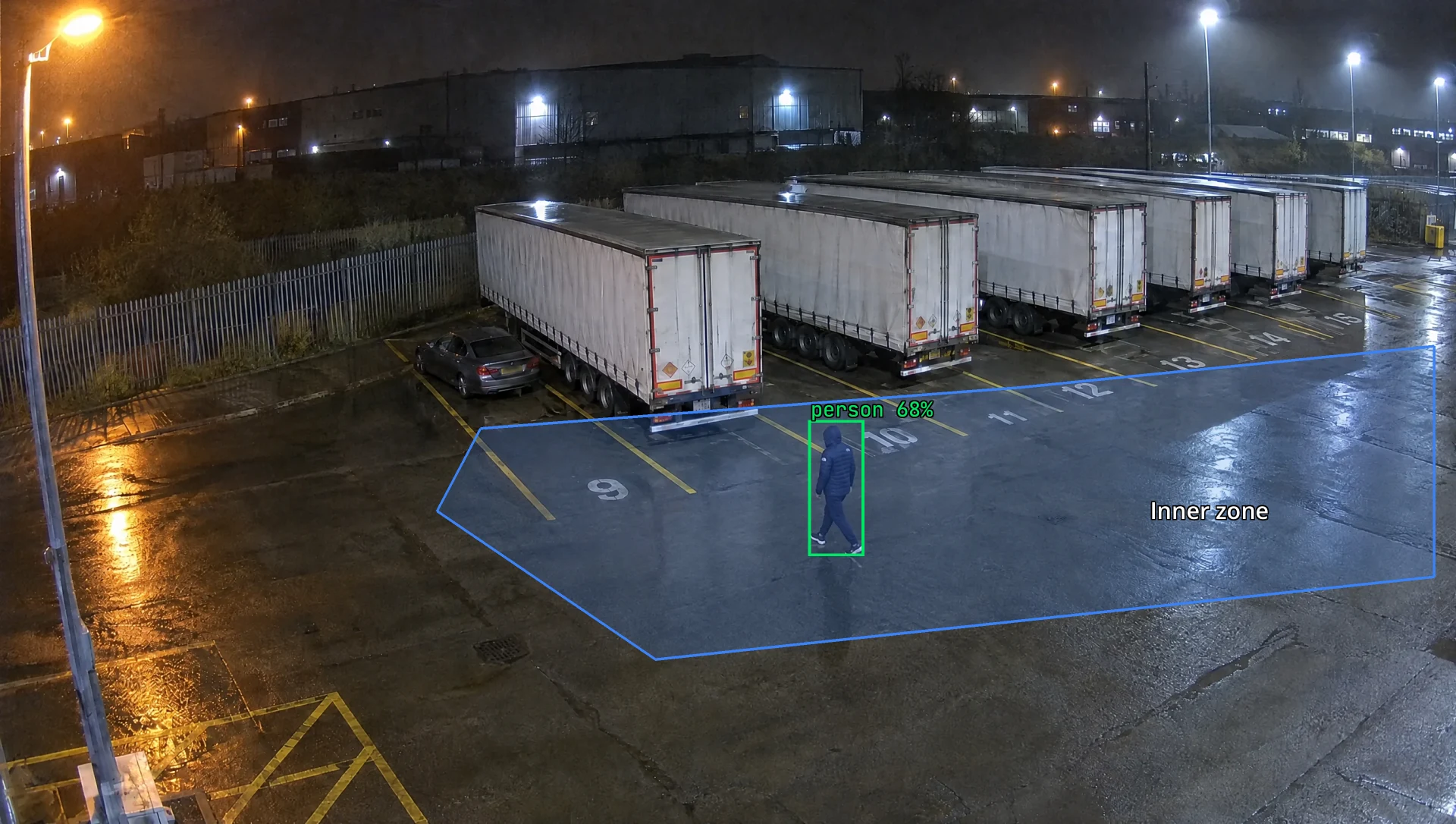 Cam 14 · Trailer park
Detection Studio
Tell each camera what matters, by drawing on it.
Draw lines and zones directly on a camera's view, set the thresholds, and give every rule its own schedule. Commissioning finds cameras with ONVIF discovery and tests each stream before it goes live.
- Lines with a direction, zones with dwell times and graded depth
- After-hours schedules per rule, plus arm and disarm per site or camera
- Per-camera health checks for a camera that has been moved, blurred, obscured or left dark
ANPR
Every plate logged. Only exact matches escalate.
Plates are read from close-up frames, logged with the vehicle and time, and searchable across your estate. A watchlist hit escalates the event and notifies at once.
- A plate ledger with first and last seen, visit counts and traffic counts
- Watchlists that match exactly; a partial read is stored but never matched to anyone
- Each plate read from its own frame, never borrowed from the vehicle before it
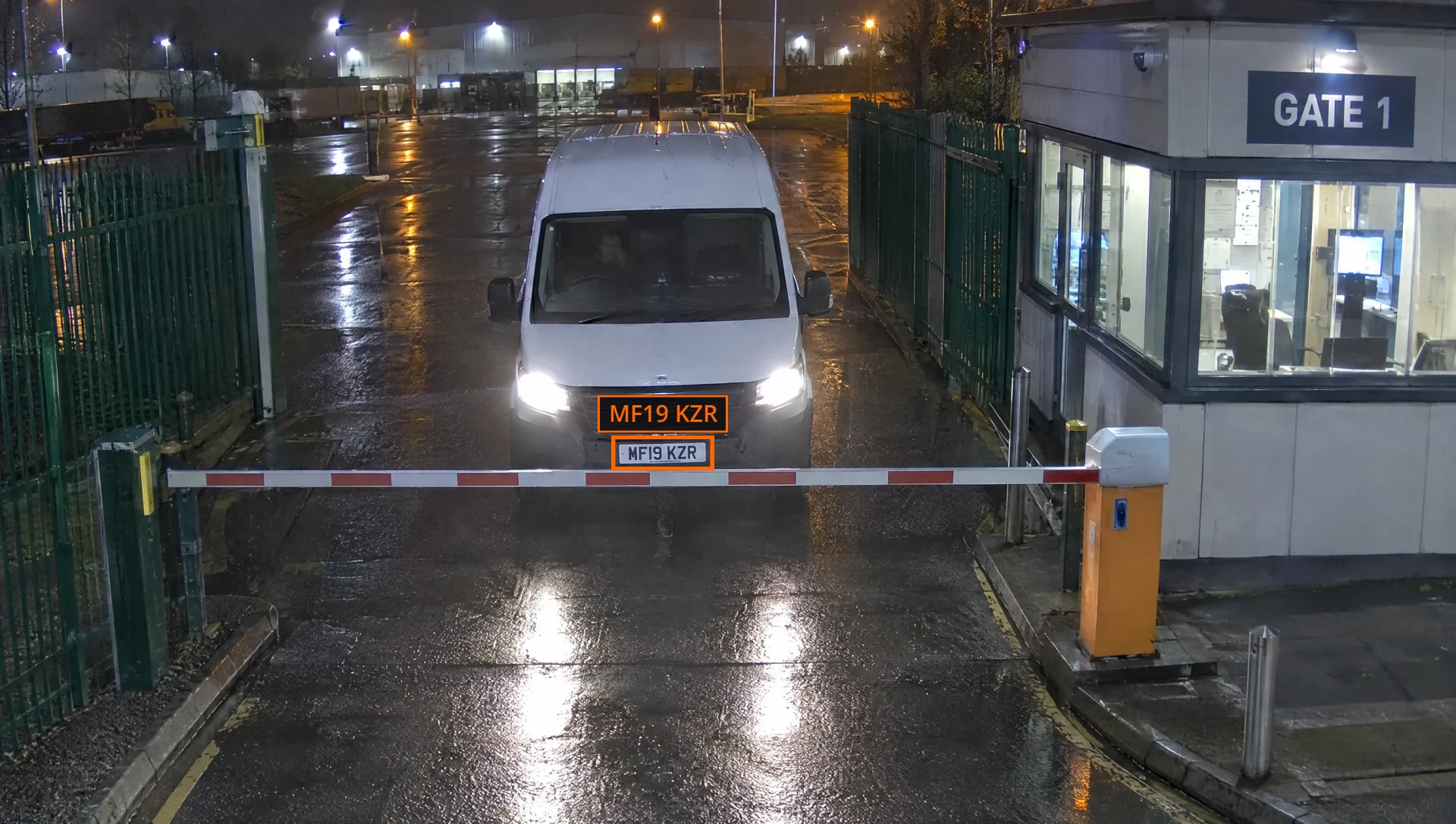 Cam 07 · Gate 1 · ANPR
After the alert
Find it, explain it, prove it.
Events explorer
Every event with its still, clip, summary and camera, filtered by site, module, severity and time.
Search by meaning
Type what you are looking for in your own words and find events whose descriptions match it.
Incidents
Group related events into one incident, with an AI-drafted narrative of what happened and when.
Evidence packs
A PDF with stills, times and SHA-256 checksums, so anyone can verify nothing was changed.
Talk-down
Cameras that speak up, in words you approved.
When someone walks into a zone you have marked out of bounds, the camera's speakers challenge them within seconds, describe them by what they are wearing and where they are standing, and get firmer if they stay.
- Only sentences from approved templates are spoken. The AI never writes what the speaker says
- People are described by their clothing, never by apparent age, sex or ethnicity
- Police are mentioned only after an operator records the call, and staff only once an alert has reached someone
- A message that would arrive late is dropped, never played
- Nothing plays until the site switches announcements on at its own edge node, for its own network
Speaker · Loading bay 3
“This is a monitored site. You are in a restricted area.”
“Person in the navy hooded jacket by loading bay 3, you are in a restricted area. Please leave now.”
“Final warning. Staff have been alerted. Leave the site now.”
Said only once an alert has reached someoneStill there? A person takes over.
Everyone who can speak on the camera gets a push and an orange “Talk-down needs a person” bar. Until someone responds, the final warning repeats every minute.
Speak through the camera
Open the Speak panel and your voice goes straight to the camera's speakers as you talk. The AI holds back while you speak and for two minutes after.
Hear the scene, keep no audio
Play the camera's own microphone, muted while you talk. Listening is switched on separately for the organisation, once an admin confirms an impact assessment, for the camera and at the edge node. Only who listened and when is kept.
Replies only from your brief
Off by default, per camera. When someone talks back, the camera answers from facts your site has approved and says plainly that it is automated. A call for help is told to dial 999, the warnings pause and a person is alerted.
Built for Hikvision, Dahua and Axis speakers, cameras with ONVIF two-way audio, SIP and RTP paging systems, or a PA wired to the edge node's own audio output.
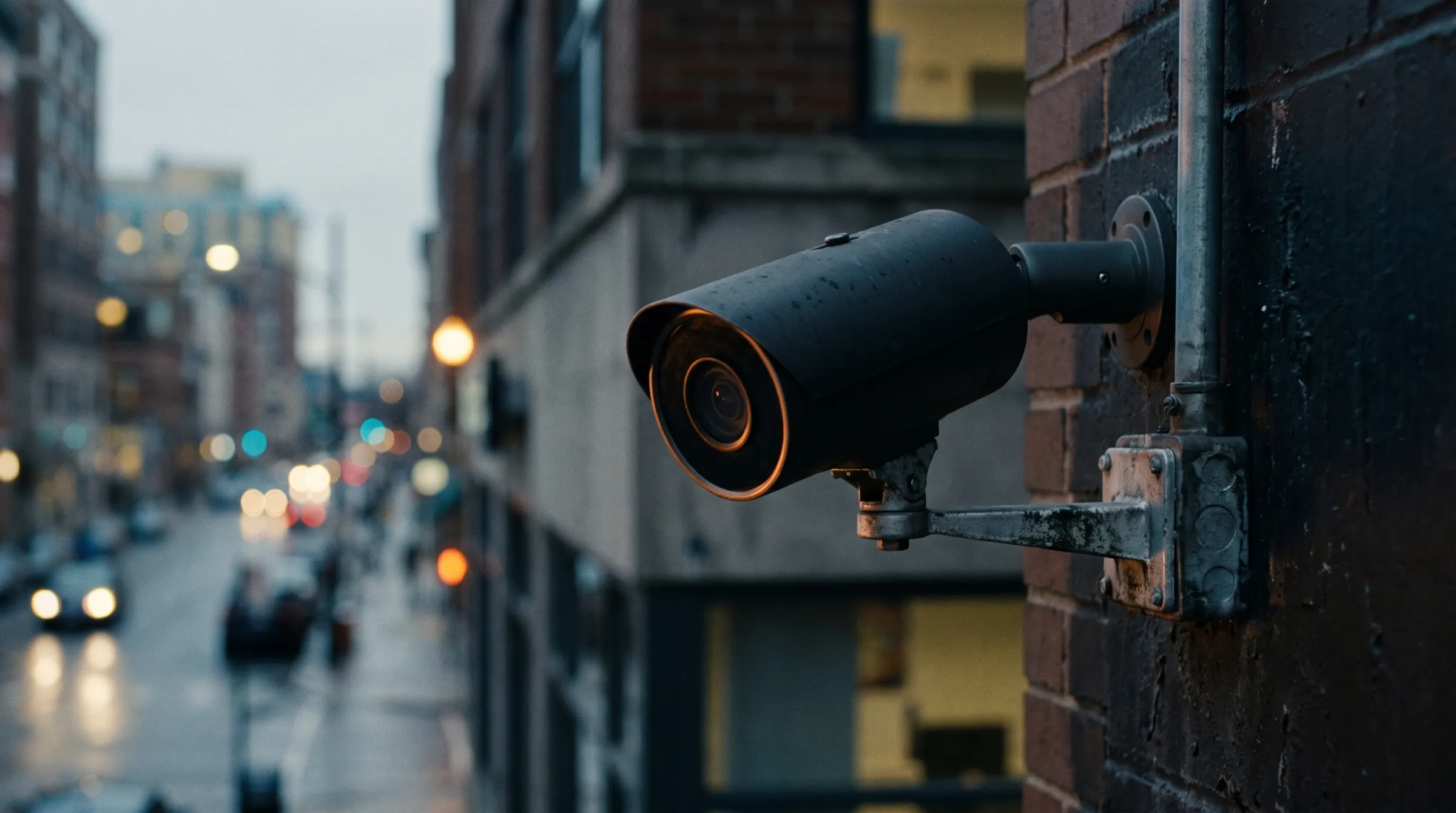
Night Guard
A patrol that never skips a camera.
Night Guard checks every licensed camera on a schedule, more often overnight, compares what it sees with what is normal there, and flags what has changed.
- Scene memory: each camera learns its own normal, so routine activity stops raising alarms
- A morning site report, emailed as a PDF with a written handover note
- A shift handover brief on demand from the assistant
- Accuracy hotspots that show which camera and module pairs need tuning
Sky Watch and Marine Watch
Cameras that know what should be in the sky and on the water.
Using the camera's position and bearing, KENAEZ matches what it sees to live aircraft (ADS-B) and vessel (AIS) transponder feeds. Known traffic is named; whatever is not broadcasting is the thing worth a look.
Passive detection and logging only. Nothing is jammed, tracked beyond view or interfered with.
What our analytics are not
KENAEZ does not record continuously, and does not replace a certified fire alarm, a leak sensor or trained security staff. Weapons, altercation and vaping modules flag moments for a human to review; they are never a verdict.
Reveal what's hidden
See every site you run on one live map.
Bring the cameras you already own. We'll show you KENAEZ on your own buildings, from the first edge node to the morning report.
14-day trial · Monthly licences · UK hosted